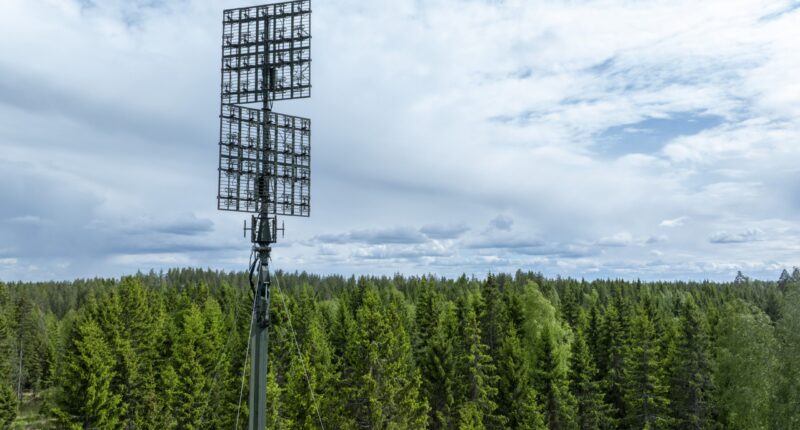
VoVisWxBw uses real-time analysis that processes more than 800,000 radar data points per hour.
Browsing Category
Next-Gen Radar & Detection
83 posts
Explore the future of radar and detection technologies.
From surveillance systems to stealth detection, we break down innovations that enhance situational awareness, improve threat detection, and ensure superiority on land, air, and sea.
British Army Tests New Surveillance Radar to Improve Artillery Targeting
GBSR is surveillance radar to monitors the movement and location of ground troops, vehicles, aircraft, and autonomous systems.
Kongsberg’s New Underwater Sonar Brings AI-Powered Threat Detection
Aegir Subsea Situational Awareness uses acoustic technology and AI-powered sonar operator service to detect underwater threats.
From Strike Weapons to Air Defense: Boeing Pursues Flexible Radar Seeker
Boeing’s ULCS device is made from cheap, off-the-shelf components repurposed for military case uses.
Australian Firm Develops Handheld Device That Reads the Electromagnetic Battlefield
RfRecon is a handheld RF intelligence device combining signal detection, direction finding, and AI processing.
Teledyne Gives Its Prism Software a New Mission: Ground ISR
Prism Ground ISR uses AI-powered target recognition, advanced computational imaging, and multi-sensor infrared and electro-optical fusion.
Patria’s New Radar Pushes High-Volume Projectile Tracking to 500 Targets
Passive radar uses Passive Coherent Location technology, television transmitters, and 100 degrees of azimuth coverage.
Teledyne’s New Vision Suite Gives Combat Vehicles Eyes in Every Direction
ThermoVision Situational Awareness HD, ThermoVision Driver Vision HD, and MilSight LIRC III are Teledyne’s 360-degree vehicle vision suite.
Air Surveillance Gets Faster With New Saab Radar Built for One-Second Scans
Giraffe AMB D uses a software-defined radar architecture, 360-degree coverage with integrated IFF, and a hydraulically raised 12-meter mast.
New 3D Search Radar Could Spot Satellites Just Hours After Activation
Scout-S uses 3D scanning, direct radiating array technology, and a modular S-band architecture to track satellites within hours of activation.