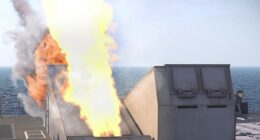

Sarcos Robotics and Technology Corp. spent two decades building Iron Man suits for the Pentagon and nearly died as a public company. The firm that climbed out of the wreckage, Palladyne AI, sells the brains instead of the body. Its CEO says one soldier could launch 200 drones with it tomorrow, and that he came back to run it for a dollar a year.
The call came from his own board, and Ben Wolff already knew what he was going to tell them.
It was late 2023. Sarcos Technology and Robotics Corp., the company he had bought out of Raytheon and taken public, had been running without him for about two years. He had stepped away from the chief executive’s job after the listing, kept a board seat, and made a point of not interfering. Now the directors wanted him to come in and give them his advice.
“I’ll tell you, my advice is probably going to be to just sell the assets and liquidate the company,” he recalls saying. “We gave it a good shot. We did our best.”

Are you building game-changing tech for defense? 💪
We’re always looking to feature innovators pushing the boundaries in autonomy, AI, energy, and beyond. If your company belongs in the Defense Disruptors spotlight, get in touch with us here.
By his account the company’s market value had fallen from $1.6 billion to about $12 million, and there was roughly $51 million of cash left. He was still the largest shareholder. “That’s hard to say about your baby, right?” he said. “After all the years that I had put in and the significant investment.”
He did not write the liquidation memo. Instead he spent 60 days with the company’s chief technology officer, Dr. Denis Garagić, who had spent 13 years as chief scientist at BAE Systems’ FAST Labs research arm before joining Sarcos in 2020 and who, in Wolff’s description, had been working on algorithms that mirror what ants and bees do in a collaborative environment since the late 1990s. “He is a super brain,” Wolff said.
“Over that time, I became increasingly convinced that while the company had failed at most everything that they had set out to do on the hardware side, the AI that he and I had dreamed of starting back in the early part of 2019 had actually progressed materially,” Wolff said. “And that it was something unlike any other architecture for AI that anybody else in the world was working on. So I said, I think there’s really something here.”
The plan he and Garagić put to the board was brutal. Lay off three quarters of the employees. Cut the burn rate dramatically. Raise money. The directors liked it enough to ask him to come back and run the company himself.
“I said, no, no, no, I’m past that. I’m enjoying my retired life,” Wolff said. They kept asking. He agreed, on one condition. “They only pay me a dollar a year. Because I said, either we’re going to make something of it, and I’ll find a path to get our shareholders a return on their investment, or not. I don’t want to get paid cash. I only want to get paid equity. So they paid me a dollar a year.”
“And now we are where we are.”
Where they are is a company called Palladyne AI, which no longer builds exoskeletons and no longer calls itself Sarcos, but which has, in a roundabout way, ended up back in the business of building weapons. It sells software that lets drones from different manufacturers hunt as a pack without a human steering each one. It sells the same underlying software to factories that want industrial robots to learn a task by watching rather than by being programmed. Since last November it has also owned an avionics house, two precision machining and fabrication shops that cut parts for the F-35 and the Tomahawk, a reusable mini bomber drone of its own, and the exclusive American rights to build Israel Aerospace Industries’ Harpy, Harop and Mini Harpy loitering munitions. Two days before this interview it announced a joint project with Federal Ammunition and Mossberg to put a shotgun on a drone and use its swarming software to shoot down other drones.
Wolff was speaking to The Defense Post on a Friday, three days before the Association of the United States Army’s annual meeting opens in Washington, where he would spend next week explaining all of this to soldiers and generals. The pitch he gives them is the same one he gave here. The interesting part is how a company that spent 20 years trying to build a wearable robot ended up selling the thing it learned along the way.

The Suit Came First
Wolff did not come to robotics through robotics. He co-founded Clearwire in 2004 and ran it as president and chief executive through its early expansion and its combination with Sprint Nextel’s WiMAX business; Sprint later bought the company in a deal Palladyne’s own materials value at more than $14 billion. He then spent five years as chairman and chief executive of ICO Global Communications, a satellite company that became Pendrell. Those were two of the three stints as a public company chief executive that he says he had promised his family he would never repeat.
Sarcos was older than any of that. It was founded in 1983 as Sarcos Research Corporation, a spinout from the University of Utah. In 2000 it took a DARPA grant to design a powered exoskeleton for soldiers, the project that became the XOS suit and earned the inevitable Iron Man headlines. Raytheon bought the company in November 2007 and ran it as its robotics division, Raytheon Sarcos. In Wolff’s telling, he and his wife bought the business from Raytheon in 2015, and he ran it as chief executive through several rounds of private fundraising, always focused on the exoskeleton.
“Going way back in time, we were the robotics division of Raytheon,” he said. “And we were focused on exoskeletons going back to 1999 and 2000, which was basically a wearable humanoid robot.”
The listing came in 2021, at the height of the market for blank check mergers. Sarcos agreed in April of that year to combine with Rotor Acquisition Corp. at an enterprise value of $1.3 billion, with a $220 million private placement from investors including BlackRock, Millennium, Palantir and Caterpillar’s venture arm, and up to $496 million in proceeds before expenses if nobody redeemed. Wolff puts the money actually raised at $260 million and the public market capitalization at $1.6 billion. He also decided it was time to go.
“I retired from the company at that point,” he said. “I actually left the company because I had been a public company CEO three times before, and I really did not want to do that again. I promised myself and my family that I would never be a public company CEO again–he life is too short category.” He had, he noted, been a successful chief executive before, growing companies and selling them for $14 billion and the like. “But I just didn’t want to do it again. And I told my board and my investors that that would be the case. If we ever went public, we would bring in a new management team.”
They did. Kiva Allgood was named chief executive in December 2021. Wolff stayed on the board and, by his own description, stayed out of the way. “I promised that I would not meddle with how the new CEO wanted to run things, because nobody wants the old CEO hanging around the hoop, being a Monday morning quarterback,” he said. “So I kind of checked out, other than doing my board duties.”
What happened next is a familiar story in the robotics industry, and Wolff tells it without much bitterness. “The new management team came in. I think they had a lot of good ideas, but they also did a couple of acquisitions. They did one really big acquisition, and it completely distracted the company, unfortunately. And there was a lot of infighting within the old team and the new team. Most acquisitions, half of the acquisitions that are done fall apart because of the people involved. And that was what happened here.”
He did not name the deal. Sarcos’s largest purchase in that period was RE2 Robotics, a Pittsburgh robot arm maker it bought in 2022. By mid 2023 the company was closing the Pittsburgh manufacturing operation, laying off about a quarter of a roughly 300 person workforce, and executing a one for six reverse stock split to stay listed on Nasdaq. Allgood was replaced in May 2023 by Laura Peterson, a former Boeing executive. In November the board shut down hardware development altogether and said it would focus on the AI software. The company ended that September quarter with $55.1 million in cash and securities and told investors it expected to finish the year with about $39 million, after $22 million to $24 million in further restructuring costs.
That is the company the board called Wolff about. “The big pivot that we did away from our exoskeleton and humanoid work was an existential moment for us,” he said. On January 16, 2024, the directors appointed him president and chief executive, effective February 23. In March the company renamed itself Palladyne AI, and in April the ticker changed from STRC to PDYN. The press release announcing his return said the company would “not let ourselves be distracted by anything that does not support” commercializing the software, which, given what he had just told the board about distraction, reads as a statement of intent.
Physical AI, Not Cloud AI
Ask Wolff what Palladyne does and he starts with a distinction he clearly makes often, because much of what follows depends on it.
“First and foremost, we are focused on physical artificial intelligence, meaning AI that is embedded in machines that makes them smarter,” he said. “Everything we’re focused on is making machines able to think about the world in which they’re operating, and to respond in real time, in a way that reduces the cognitive load on a human operator.”
The customer logic behind that is not subtle. “As you think about where the Department of War wants to go, with reducing reliance on manpower so that we can effectively field more weapons in the field at one time, that’s a big driver,” he said. The Pentagon, which Wolff refers to throughout by its restored name, has spent the past two years telling industry it wants cheap, numerous, attritable systems and fewer people tied up running each one.
“So we’re not talking about the kind of AI here that sits in the cloud and helps you and I get more knowledgeable about something, or the kind of AI that helps us make decisions,” he said. “This is actually AI that sees and perceives what’s going on in the real world, and responds by giving direction to the machine about how to act in the physical world.”
The company applies it in two places. The first is drones, and the specific product is a swarm that one person can launch and then largely leave alone.
“The specific implementation is enabling a swarm of drones to be launched by a single human after the human gives the swarm a high level mission parameter,” Wolff said. “And then those drones can actually react and respond independently and collaboratively in real time to what’s going on on the battlefield, either in the air or on the ground. So as conditions change, as the enemy does different things on the battlefield that might not have been expected or known, the drones, without seeking permission from the human or direction from the human, can actually respond in real time, as long as it’s consistent with the mission parameters that the human assigned to it.”

Unmanned Is Not Autonomous
That, he argues, is not what most of the industry means when it uses the word autonomy, and he has written white papers saying so. “Autonomy and unmanned are not the same thing, but people try and kind of blur those distinctions,” he said. “Unmanned is great, and it’s better than manned in a lot of cases, because we’re not putting human lives at risk. But autonomy does not mean just putting in waypoints and launching the drone. Because what happens if the target changes? What happens if the objective changes? What happens when the circumstances on the battlefield change? And of course it always changes. So we’re trying to deal with that real time responsiveness.”
He held the line on the definition even when it was offered as a compliment. When the interviewer suggested that the military has been using autonomy for years, pointing to Patriot interceptors that fire faster than a human could decide, Wolff cut in. “I would say that it’s automated, not autonomous,” he said. “It’s unmanned.”
The argument has a paper trail. In a post on the company’s site published September 16, three weeks before this interview, Wolff wrote that autonomy had become one of the most overused words in defense technology, turning up in everything from PowerPoints to budget documents, with companies bending it to fit whatever they were selling. He anchored his definitions in ASTM International’s aviation standards, under which an autonomous system can work out a new course of action with no predefined plan, while an automated system merely runs a predefined process without a human touching it. Waypoint flight, collision avoidance, formation flying and object tracking are all useful, he wrote, but they are automation. His example was a drone told to follow a vehicle. If the vehicle stops and a passenger gets out and runs, an automated drone stays with the vehicle, because that is what it was told to do. An autonomous one understands the mission priority, notices what changed, and follows the person.
Unmanned, in his telling, is a third thing again. It describes the platform, not whoever is deciding. A drone flown by a soldier with a joystick in each hand is unmanned and also entirely manual. A system can be unmanned and manual, unmanned and automated, or unmanned and autonomous, he wrote, “three very different capabilities that happen to share the same empty seat.” The post also names the philosophy behind the software, Decentralized Embodied Collaborative Autonomy, or DECA, and reaches for the biology Wolff reaches for in conversation: ants do not wait for the queen to tell them what to do, bees do not either, and wolves hunting as a pack do not work from a fixed script.
The drone work is funded. Palladyne has contracts with both the Air Force and the Army, Wolff said, “to both evolve the technology and demonstrate it in real world exercises.” The Air Force side is a Strategic Funding Increase, or STRATFI, agreement for the Palladyne IQ embodied AI architecture; an option exercised this year took the total program value past $10.6 million. The next step, he said, is pulling in sensors that are nowhere near the drones.
“We’re working on efforts to incorporate data that comes from sensors that are in space on satellites, from sensors on the ground, and sensors that are in the air,” he said. “So we take a multidomain approach, share that knowledge across all of the drones in the swarm, and it is kind of the equivalent of having a team of humans on the ground. A team of humans in a squad, or a platoon, are always going to have more collective knowledge than the sum of the parts. That’s the same thing that we’re doing for drones.” The company’s first quarter results this year described a planned integration of its autonomy platform with space based assets, and Wolff has said publicly that Palladyne is pursuing missile defense work.
A Target Described in Plain English
Asked about how a swarm like this actually works in practice, Wolff reached for the oldest comparison in precision warfare.
“Think about the way missiles have historically worked,” he said. “When you launch a missile, you have to put in predefined coordinates for the strike. With our technology, you don’t need a preprogrammed coordinate. You can have a high level plain English description of what you want your target to be. And the drones can loiter, depending on the size of the drone, for an extended period of time. And once they identify something that meets your criteria, they can come back and check in with you. Here’s our confidence level that we meet that criteria. You can have other data points, whether they’re space based or ground based or whatever else they might be, to help validate that. And then the commander can make a decision to execute.”
What the commander does not have to do, he said, is fly. “Without having to have soldiers fly the X, Y, Z coordinates on the drone, and then also manage the sensors, the camera, the pan tilt zoom, all of that stuff that takes cognitive load. Our whole objective is to get the soldier’s head back in the fight, so that they’re not completely consumed and occupied by how to fly the drone. They can instead be thinking about, what’s the intelligence that the drone swarm is gathering?”
He illustrated the point with a conversation he had with someone who trains Ukrainian drone operators and runs a school that, he said, has trained thousands of them.
“He told me that in Ukraine, to fly one drone, they typically have three soldiers involved in flying the drone. And I thought, why is that? I mean, I understand one to one. But why do you have a three soldier to one drone ratio? And they said, because what most people don’t realize is that that drone operator becomes a really big target. You’re out there with your head focused on this little screen, and you don’t have your heads up awareness of who might be coming after you as the operator. And so they’ve got two other guys there helping the guy make sure he’s safe.”
“And I thought, that is messed up,” he said. “Our whole objective is to fix that.”
The white paper makes the same point in cooler language. Its worked example is a reconnaissance swarm covering a convoy through a contested city. At the lower autonomy levels, each drone needs its own operator and sometimes extra people for the camera and for coordination, so growing coverage from one drone to five usually means five operators and a supporting crew. If one aircraft is jammed or lost, the coverage disappears until another crew can be found. At Level 4, by the paper’s description, one person supervises the whole swarm and the aircraft reposition themselves.
‘We Could Do It Tomorrow’
The technology has been through two Army events this year. In May, at the 4th Infantry Division’s Ivy Mass exercise at Fort Carson, Colorado, the company says SwarmOS let drones from multiple manufacturers operate under a single soldier who had been trained on the system in under 30 minutes. Over the summer it went to Project Convergence Capstone 6, the Army’s division scale test of how it expects to fight, where the company says aircraft from several vendors found targets, shared what they saw through the Army’s command and control network with a soldier in the loop, and then directed Palladyne’s own Gremlin-X mini bomber to strike, with the soldier keeping the decision to engage. Wolff put the number of drone makers in that single swarm at four.
Asked how close drone swarms are to being used at scale in real combat, he did not hedge.
“We have the technology that enables us to launch hundreds of drones by a single operator, and to not just have them all go attack a preprogrammed target,” he said. “I’ll tell you right now, if the US Army said, we want to go fly 200 disparate drones in a coordinated mission using Palladyne software, we could do it. I mean, we could do it tomorrow. We need the time to retrofit our software onto whatever drones they want to use and make sure the sensors and all of that work and that the radios work. But the technology exists today.”
That was not the reception he got when he started. “Some people in the Pentagon are talking about it, well, that was on a roadmap for 2032 or 2035,” he said. “That was kind of the talk two years ago when we first got started, and we were a little discouraged by that. Clearly that has changed now.”
The white paper ends on the same number. “We don’t have to wait until 2032 to deliver this capability. It exists today.”
He offered an unexpected benchmark for how far public imagination has run ahead of the battlefield. The third season of Lioness, the Paramount+ spy thriller, opened in August with an episode in which an American team on the Russia Ukraine border is hunted by a swarm of explosive drones. “It’s an interesting fictionalized depiction of what might be going on in Ukraine with drone swarms,” Wolff said. “And I’ve been asked by a couple of folks in the media, is that real? And the answer is, it’s not real in Ukraine today, from what I know. That is all Hollywood. But the answer is, if somebody wanted to make it real today, all they need to do is put our software on their drones.”
On Anduril and Shield AI
The obvious question for any company making that claim is what Anduril and Shield AI, the two best funded names in American defense autonomy, cannot do that Palladyne can. Wolff answered it carefully, and with a caveat he asked to have preserved.
“My understanding, and this is just based on third party information, I don’t know these companies intimately well, I don’t believe that Anduril does any edge based true autonomy,” he said. “Lattice is a centralized network, and we actually have integrated our software, at the Army’s request, with Lattice. So Lattice provides a battlefield management perspective, an overall view to the commander of what’s going on. And the AI on our drones feeds data and information into Lattice so that it provides data points for Lattice’s overall integrated C2 system. So that’s how we differentiate from Lattice.” Palladyne’s own announcements from both Army exercises describe SwarmOS running inside Anduril’s Lattice, which is to say the two companies were on the same network at Project Convergence, one as the picture and one as the thing moving inside it.
From there he listed what he believes sets the company apart from everyone. “First of all, our intelligence only sits on the drones themselves. It does not sit in a central node. Number two, it is platform agnostic. So it can sit on anybody’s drones that has enough compute power. And we can enable a heterogeneous swarm. So we’re not just beholden to Palladyne’s quadcopters, for example.” Then the Project Convergence swarm of four makers’ aircraft. “That is unique.”
“Another thing that is unique is we work in comms challenged and GPS challenged environments. I’m not sure if anybody else can do that. Most importantly, we’re not just preprogrammed flight. When I have looked at other companies that talk about autonomy, when you really peel back the layers of the onion, they’re talking about preprogrammed flight, either with waypoints, or they’re talking about collision avoidance. Pretty rudimentary levels of automation. Not true autonomy, where a swarm of machines, a group of machines, can interface with each other, share knowledge about what they’re perceiving on the battlefield and respond in real time without requiring human direction. That’s what is different.”
On Shield AI he was more guarded still. “I don’t know a lot about what Shield AI is doing. I’ve read some of the marketing materials. I don’t believe that their software does what we do, based on what I’ve heard from people in the military, but that’s about the extent of it. So I wouldn’t want to be quoted as saying we know definitively that we do something different than them. But I can tell you, we’re not running into them when we’re talking to folks in the various branches of the military. I think that most of the US military’s focus on them right now is on their hardware platform and how that hardware platform can be better, and is better, with the leverage of advanced autonomy capabilities.”
Kilobits, Not Megabits
The comms question is the one Ukraine has made unavoidable. Palladyne says its software is built for degraded communications; the interviewer asked what the company had learned about how autonomy holds up under real electronic warfare rather than on a test range.
“What I’ve heard from Ukraine is that it is worse than anything we have planned for,” Wolff said. “The communications environment is just a complete mess. And communications challenged, or communications denied environments, that’s a broad terminology to describe a whole litany of different things that can create problems on the battlefield.”
His answer has two layers. For a single aircraft: “If the operator loses connection with the drone entirely, it can still complete its mission, because the intelligence lives on the edge.” For the swarm, the design principle is to say as little as possible, as rarely as possible.
“We have designed the system so that it uses very, very limited amounts of data being interchanged between the drones. So think of very small packets. We are talking about kilobits of data, not megabits or gigabits. And because it’s such small amounts of data that needs to be transmitted, and only intermittently and sporadically, we can transmit and retransmit, and we can frequency hop using the radios, depending on the radios that are on the drones, to try and in effect evade and get around whatever communications blockages or jamming is going on.”
“So each individual drone can go off and do its own thing,” he said. “The drones get smarter if they can collaborate. When they can collaborate, they only do it when they need to, and it’s only using very limited kilobit size packets of information, so that you can try and intelligently get around whatever is causing interruption in the comms environment. It is about the best solution that we can think of to still enable swarms to work autonomously.”

Where the Human Sits
All of which raises the question the whole industry would rather not be asked directly: where the human sits when the machine is this capable, and where Palladyne draws the line on lethal autonomy.
“Our architecture enables humans to intervene at any point,” Wolff said. “It doesn’t have to be a lethality decision. We have the flexibility in our architecture, if you’re in the Army and you want to say, hey, I want decision points at X, Y and Z, we can give you that. It’s completely flexible. Our view from an ethical perspective is, before a kill decision is made, before an execution decision is made, a human ought to be making that decision, and so we embed that in the software.”
He was equally direct about what the software is not. “I think what the public misunderstands about AI is there’s nothing in our software that is Terminator like. It is not sentient. It can’t go rogue and decide to do something on its own. It doesn’t have that capability. That’s one of the beauties of the way our architecture works. It can only work within the confines of what we have told it to do. It can’t jump outside of those confines. So it is entirely subject to whatever commands, mission profiles, whatever it is that we, the operators, give to it.”
Then the admission that the line is a policy choice rather than a technical limit. “You could theoretically say, just go execute on this mission with no human intervention. I’m afraid that someday we will have adversaries that use weapons like that. So we have designed our architecture so that the government, the customer, gets to decide where they want human intervention. And it is possible at every step, or any step, along the way.”
The Factory Floor
The second place Palladyne puts its software is a long way from any battlefield. It is the factory floor, and the pitch there is about productivity rather than lethality, though Wolff frames even that as a defense problem.
“The second thing that we’re doing with our artificial intelligence is we’re enhancing the capability of the defense industrial base by using our AI to improve productivity and output in manufacturing,” he said. “And the way we do that is by putting our artificial intelligence on manufacturing robots, enabling those robots to be trained to perform a new task in a much shorter period of time. And beyond just the training more quickly, it also enables them to become multifaceted in their capabilities. So they can do a number of different tasks.”
“Today, if you go into a manufacturing facility with a robot, that robot likely is doing the same thing 24/7,” he said. “All it does is that single repetitive task. With our capability, we can now use a robot much the way we use humans. They can be diverse in their application. They can do a lot of different tasks, because we’re enabling that robot to think like humans, to reason like humans, and to sort through things that it hasn’t been trained to do.”
The product is Palladyne IQ, and a second version was released commercially earlier this year with what the company described as an initial customer signed after a year of refinement. “So the two commercial products, both launched earlier this year, both focused on giving machines the ability to be smarter and to reason like humans,” Wolff said. “That’s the crown jewel of what we do.”
The Brains of the Suit
What makes the story coherent, rather than a software company that happened to stumble into drones, is where the software came from. It came from the suit.
“That technology evolved from our effort with the Department of War around exoskeletons,” Wolff said. “We had a program early on with SOCOM and with the Air Force, to be able to not only have a human wear this robot that would give you superhuman strength, but to evolve that robot to be able to operate in the real world without a human inside of it. So it could be trained while being worn by the human. If you had it on, you would actually go do a task, and the robot would learn from you how to do that task perfectly, the way we humans have learned how to do a task. We learn by doing, not by writing a bunch of code. And so this was a low code or no code approach to training a robot.”
“So, although we never brought the exoskeleton to market, the brains behind the exoskeleton are being deployed in both mobile and in fixed scenarios.”
Back Into Hardware
There is an irony in what happened next, and Wolff is aware of it. A company that nearly died trying to build hardware, and saved itself by swearing off hardware, is building hardware again. His explanation is that the software was good enough to expose how unready the rest of the market was for it.
“Because of our success and progress on the drone side, we’ve discovered that a lot of drones and other UAVs that are out there don’t have the innate ability to fully leverage our AI capabilities,” he said. “So we thought, well, what better way to show the world and the Department of War what our AI was capable of doing than to start creating both components that could leverage our AI and full weapon systems that leverage our AI?”
He reached for a car company. “The analogy here is, if Tesla had only come up with the software, the AI for self driving cars, and tried to sell that to Ford and GM. Well, Ford and GM’s cars weren’t optimized to be able to leverage that software. Similarly, while other drones can use our software and are using our software, companies like Red Cat and Draganfly and others are using our software, they’re not optimized to really be able to leverage what our AI can do.”
“So now we’re in the drone business,” he said. “We’re doing it, though, in a very discrete, unique way. We’re tackling hard problems that others are not really trying to tackle. So we’re not just another FPV drone company.”
The vehicle for that was a set of acquisitions announced last November. For about $31 million in stock, cash and assumed debt, Palladyne bought GuideTech, an avionics and flight software house staffed, by the company’s description, with former prime contractor engineers who had designed missiles and unmanned aircraft, along with two manufacturing businesses, Warnke Precision Machining and MKR Fabricators, whose shops supply parts for the F-16, the F-35, the Tomahawk, the Harpoon and the Bradley. Together with the defense version of the drone software, now branded SwarmOS, they became Palladyne Defense. GuideTech brought its BRAIN avionics line and two weapons projects, a loitering munition called Banshee and a cruise class munition called SwarmStrike. In February the company flew what it calls IntelliSwarm, the SwarmOS software fused onto its BRAIN X2 flight computer, on a Banshee airframe collaborating with Red Cat drones.
Wolff described the resulting portfolio from the small end up. “We’ve got a mini bomber quadcopter that is fairly unique, the ability to precision drop ammunition, leveraging our artificial intelligence, on a small form factor,” he said. That is Gremlin-X, the reusable mini bomber that flew at Project Convergence.
“At the other end of the scale, we have a partnership with IAI to bring their large form factor loitering munitions to the US for suppression and destruction of enemy air defenses, filling a big gap that’s in the US arsenal.” That agreement, signed in June, gives Palladyne exclusive American production and marketing rights to the Harpy, Harop and Mini Harpy, a family IAI has been selling to foreign militaries for decades and which has been used in combat, including by Azerbaijan against Armenian forces. Palladyne is to adapt the designs to US requirements and build them on an American line.
“And we make components that we sell to other OEMs, defense primes, such as avionics, compute, and also precision machined components,” he said. “We’re on everything from missile programs to the F-35 and everything in between. So we’ve got a vertically integrated stack on the defense side. On the commercial side, we’re only software.”
He caught himself at the end of it. “So that’s a long, lengthy description of our business.”
The numbers behind it are small but moving quickly. Palladyne reported $5.2 million of revenue for all of 2025 and is guiding to between $24 million and $27 million for 2026, a jump that follows the acquisitions. Preliminary second quarter revenue was about $5.8 million against a backlog of roughly $24 million. The company had $43.7 million in cash and securities at the end of June and expects to burn $8 million to $9 million a quarter on average this year, which is the arithmetic every investor in the stock is doing. In February it moved a longtime board member, Matt Muta, into a new job as president of the commercial and industrial business, with a brief to accelerate revenue.
What Ukraine Taught Washington
The second half of the conversation turned to the war that has reorganized this industry, and to what it has done to American assumptions about who leads in military technology. Wolff’s answer started with national character rather than hardware.
“Americans have prided themselves, for most of our country’s history, in being the leaders in the world in innovation,” he said. “That is the one thing that Americans can feel very proud about. No matter what else is going on, we always think we are the most innovative in the world. Everybody else wants to copy what we do. So when you have, whether it’s the Ukrainians, or the Israelis, or anybody else, that comes up with a way of doing something better, faster, cheaper, more innovative than what we Americans do, it gets our attention. As a people, it gets our attention. It certainly gets people in the administration, the Department of War’s attention, when a shift happens that we didn’t predict, that we didn’t see coming. And that gets our attention in a big way.”
What drove the shift, in his view, was not cleverness but survival. “In both the case of the Ukrainians and the Israelis, they’re fighting for their survival. They’ve got people on their borders that want to take them over, wipe them out, however you want to describe it. And so, necessity is the mother of invention. When your lives are at stake, you find ways to adapt. And that means innovation.”
“We have had the luxury here in the United States, with the exception of 9/11, of having oceans on our borders, and friends on our other borders,” he said. “And we haven’t had that need. We’ve had a capitalist mentality, which drives some innovation, but we have not had a life or death mentality.”
Then, unprompted, the personal part. “I’ve had family members that have served. They have had a life or death mentality. That’s frankly what motivates me to do what I do today. I want to protect our warfighters. I want to keep them out of harm’s way. I also want to keep civilians, even in our adversary countries, out of harm’s way, because they are not the warmongers, right? They’re not in control. So to the extent that we can develop products that protect our warfighters, number one, and prevent unintended consequences, like civilian casualties, I want to put every ounce of my energy into that. And that’s what drives me and motivates me.”
Back to the question. “I think that we have seen that other countries that we don’t think are peers in any way, shape or form are able to out innovate us,” he said. “They’re able to bring things to market much more quickly. They’re able to completely change the nature of warfare. And this notion of air superiority that we used to think meant launching new fighters, things like that. It is still air superiority, but it’s of a different flavor. When you’re talking about truly having troops on the ground kilometers away from each other on a battle line, you’re talking about small drones. And you’re talking about having, basically, smart munitions that fly through the air. Flying grenades, effectively. That is a different type of a mortar, in a way. We’re evolving in warfare. You started with cannons back in the 1300s. Today, cannons have evolved into things that fly with some intelligence, with mortar rounds on them, effectively.”
He set Iran beside Ukraine as the other data point. The United States and Israel began a large scale air and missile campaign against Iran at the end of February, and Iran answered with missile and drone strikes across the Middle East. “In Iran, it’s another type of unmanned war,” Wolff said. “Because of distances, you’re not talking about Group 1 quadcopters, but you’re talking about missiles of all different types, loitering munitions, things like the MQ-9 Reaper. So it’s just a different scale. But overall, the message is the same. Hey, United States, we’re not fighting the same old war anymore, and you better figure out how to do things more quickly.”
He believes the message has landed, and he is realistic about what acting on it will cost. “I think that the Department of War and the White House now understand that fully, and we’re going to throw a bunch of effort at trying to make things happen quickly, with an understanding that not all of it’s going to work out. And yes, we’re going to waste some money here and there. But at least, at the end of the day, we’re going to have gotten the rust knocked off the machinery, and we’re going to get the machinery moving more quickly to try and keep pace with the adversaries that, I mean, if Ukraine can do what they’re doing, what can China do? Right? That’s the concern.”
‘A National Treasure’
He came back, at the end, to the board call that started all of this. “That was the pivotal moment,” he said. “And it was really an existential moment. Are we going to sell off the business or shut it down? Or are we going to try and dig deep and turn this into the crown jewel that I think it is?”
It is a long way from an Iron Man suit. The through line, if there is one, is that Sarcos spent two decades teaching a machine to learn by being worn, failed to sell the machine, and kept the lesson. Wolff’s bet is that the lesson is worth more than the suit ever was, and that the country needs it more than it knows.
“I really believe that what we saw back two and a half years ago, and what we have today, it is a national treasure,” he said. “It is a national asset. And it is something that I hope our country can find a way to truly exploit to our advantage.”