
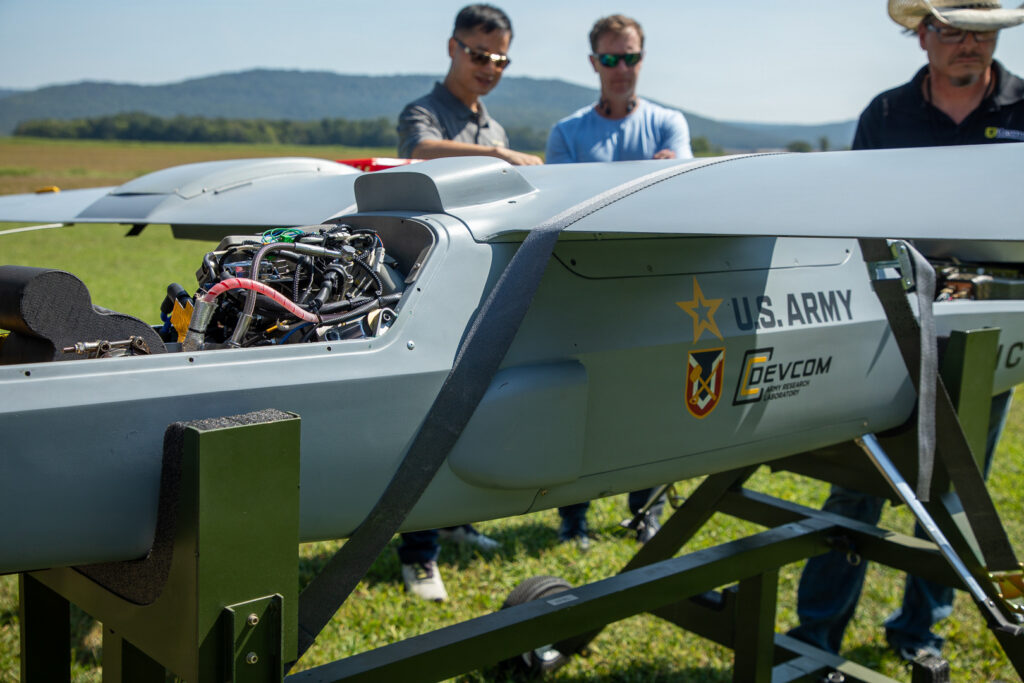
A new propulsion design is giving the US Army’s VICTOR drone a different kind of power, combining a 3D-printed rotary engine with an electric motor to improve flight performance.
The propulsion system recently completed a successful flight demonstration after years of research by the US Army Combat Capabilities Development Command’s Army Research Laboratory.
The project aims to help tactical drones fly longer and faster, carry heavier equipment, and operate at higher altitudes without placing additional demands on military supply chains.
“For warfighters, the program has transitioned research findings to industry partners for maturation and integration into capabilities that could enable mid-sized drones to operate beyond line of sight, extending the reach of ground commanders and reducing risk to soldiers,” said Dr. Chol-Bum Kweon, the program’s manager.
A Different Way to Power Military Drones
At the center of the system is a heavy-fuel rotary engine connected to a 400-volt motor-generator, creating a hybrid setup designed for vertical takeoff and landing operations.
Army researchers used computer modeling to improve how the engine burns fuel, while 3D metal printing made it easier to redesign and test components as development progressed.
“The use of advanced manufacturing, including 3D metal printing, allowed us to rapidly redesign engine components based on lessons learned through experimentation,” Kweon explained.
“It enabled us to design an air-cooled engine that reduces propulsion-system size and eliminates the need for liquid coolant.”
The US Army is looking to build on the research to expand VICTOR’s capabilities, including exploring how multiple aircraft could work together in coordinated missions.