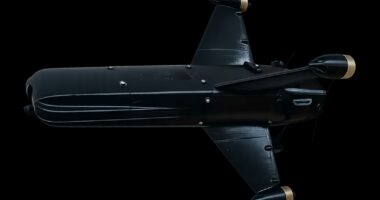


General Cherry is bolstering Ukraine’s air defenses with a new one-way interceptor designed to clip the wings of Russia’s Iranian-supplied Shahed loitering munition.
Known as Bullet, the interceptor can reportedly reach speeds of up to 310 kilometers (193 miles) per hour, operate at altitudes of six kilometers (19,700 feet), and sustain flight for around 25 minutes.
It features target recognition at distances of up to 600 meters (1,970 feet) and carries a nearly one-kilogram (1.8-pound) warhead with a 20-kilometer (12-mile) strike range.

Bullet also uses four electric motors mounted on the tip of its delta wings in an X-shaped layout, all powered by a high-capacity internal battery.
According to its developer, the design and onboard software support terminal guidance, allowing the interceptor to maneuver more effectively as it closes in on a target.
In terms of communications, its radio control operates across 270 megahertz to 2.9 gigahertz frequency, while video transmission spans 1.2 to 7.2 gigahertz.

From Lab to Battlefield
Unveiled at Unmanned Systems Exhibition 2026, Bullet is reportedly priced at $2,100 per unit and has been officially approved for use by the Armed Forces of Ukraine.
This clears the way for mass production as Kyiv expands its counter-drone toolkit.
The program previously drew scrutiny after rival Ukrainian firm Wild Hornets alleged similarities between Bullet and its own designs.
General Cherry has since stated that the interceptor has multiple configurations, and that the final production model differs significantly from early prototypes.
Prior to codification, multiple Bullet variants were distributed to more than 20 frontline units for evaluation under real combat conditions.