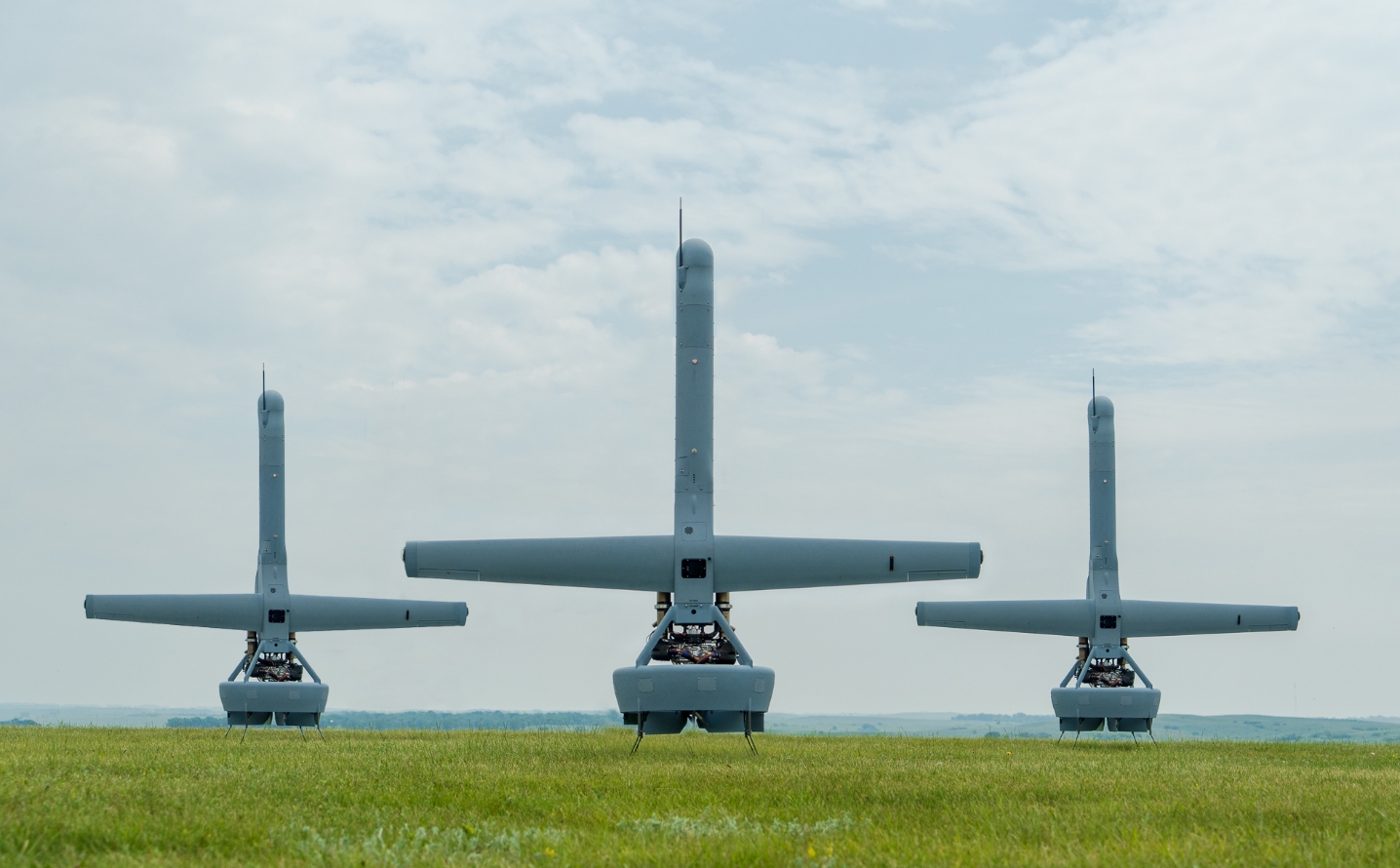

The V-BAT just got new teeth.
Shield AI is arming its vertical takeoff and landing (VTOL) drone with South Korea’s laser-guided missile, turning the platform into a compact, precision strike asset.
The missile, known as LIG Multi-purpose Drone-launched Missile (L-MDM), is an air-to-ground weapon developed by LIG Nex1 for integration with rotary or fixed-wing intelligence, surveillance, and reconnaissance (ISR) drones.

It features a modular architecture and uses laser guidance to accurately engage targets from a distance, reducing operator exposure.
On the other hand, the V-BAT blends vertical lift with fixed-wing cruise, letting it launch from confined spaces like ship decks, forest clearings, or improvised forward bases.
The drone spans 3.8 meters (12.5 feet), weighs up to 75 kilograms (165 pounds) at takeoff, and can carry up to 18 kilograms (40 pounds) of payload depending on configuration.

A key feature is Hivemind autonomy, which handles navigation, sensors, and recovery with minimal operator input, even in GPS-denied or electronic warfare environments.
The V-BAT and L-MDM combo is meant to give frontline units a stand-alone strike option when traditional close air support is out of reach.
Next Phase: Testing
UMEX 2026 served as the public kickoff for the integration contract, setting the stage for flight-tests and performance evaluations of L-MDM on the V-BAT.
It was attended by LIG Nex1 Chief Executive Officer Ik-hyun Shin, Shield AI Executive Vice President of Business Development and Strategy Bob Harward, and other representatives.
Now the work shifts to proving the missile’s handling, targeting, and mission reliability in real-world conditions.
The collaboration also signals deeper US-South Korea ties in tactical unmanned strike systems.