

US Northern Command has taken a major step in domestic drone defense, certifying its new counter-drone fly-away kit after a weeklong live deployment at Minot Air Force Base.
Designed for layered base defense, the kit merges sensing, tracking, and kinetic engagement to locate and defeat hostile drones.
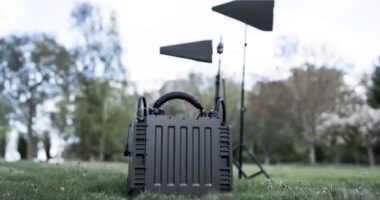
At its core, the kit features the Heimdal mobile sensor trailer, which provides autonomous 360-degree radar and thermal imaging for target acquisition.

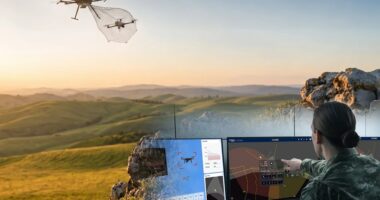
Working alongside it, Anvil interceptor drones and a launch unit detect, track, and physically engage airborne threats, while the Pulsar, an electromagnetic warfare effector, handles radio-frequency detection, classification, and denial capabilities.
The Wisp wide-area infrared suite ties the system together, using AI-driven, continuous 360-degree full-motion sensing to give operators a persistent view of the airspace.
Cohesive Team, Real-World Readiness
Conducted in October, an 11-member team deployed the system to support the 5th Bomb Wing at Minot, engaging over 100 aerial targets in extreme North Dakota weather.
The exercise marked the kit’s first full-scale field evaluation, from mobilization and transport to detection, engagement, and recovery.

According to Maj. Austin Fairbairn, who led the mission on the ground, most members of the team had no prior background in drone defense.
However, the group adapted quickly, mastering system controls, calibration, and tactical employment to form a cohesive counter-small unmanned aircraft system (C-sUAS) team.
The deployment also included legal and procedural work to update Minot’s 10 U.S.C. 130i C-UAS defense plan, clarifying base commander authority to respond to drone threats.
The team had previously trained with the kit during Exercise Falcon Peak 25.2 at Eglin Air Force Base in September, shortly after its delivery from Anduril Industries.
“We brought together a group of people from different career fields, military services, and an assortment of personalities and turned them into a high-functioning team of C-sUAS professionals,” Fairbairn added. “I’m both grateful and humbled to have led such a skilled team of dedicated military professionals.”