

Dutch defense firm Destinus is taking a more targeted approach to point defense, focusing its intercepts on projectiles headed for critical military and infrastructure assets rather than engaging every threat.
Its answer is Vorexon, a ground-based interceptor concept that can travel at speeds exceeding Mach 2 (2,470 kilometers/1,535 miles per hour) and engage targets more than 20 kilometers (12.4 miles) away.
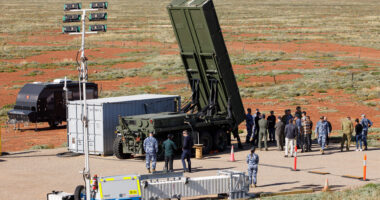
The weapon can be launched from fixed or mobile multi-round canister launchers, allowing flexible deployment across a range of operational environments.
While primarily designed to counter artillery rockets and selected artillery shells, Vorexon can also engage subsonic threats such as cruise missiles and glide bombs.

A New Layer for Existing Air Defenses
The system is intended to protect command posts, air-defense radars and batteries, ammunition depots, bridges, logistics hubs, and other high-value sites.
Rather than replacing existing air defense systems, Vorexon is designed to complement them as an effector within an integrated sensor and fire-control network.
External radars detect incoming projectiles, predict their impact points, and prioritize those threatening critical assets before the interceptor is launched.
During flight, Vorexon receives guidance updates until a planned active radar seeker takes over in the terminal phase. Human operators remain responsible for engagement decisions throughout the process.

Closing the Cost Gap
According to Destinus, the concept comes as artillery rockets continue to play a growing role in modern warfare, including the Russia-Ukraine conflict.
The company noted that Russia at one stage fired an estimated 20,000 artillery rounds per day, leaving defenders with little time to protect critical assets.
Destinus also argued that using costly interceptors against large numbers of low-cost artillery rockets may not be sustainable over time.
Vorexon is therefore being designed for scalable production, with the goal of making point defense more cost-effective.