
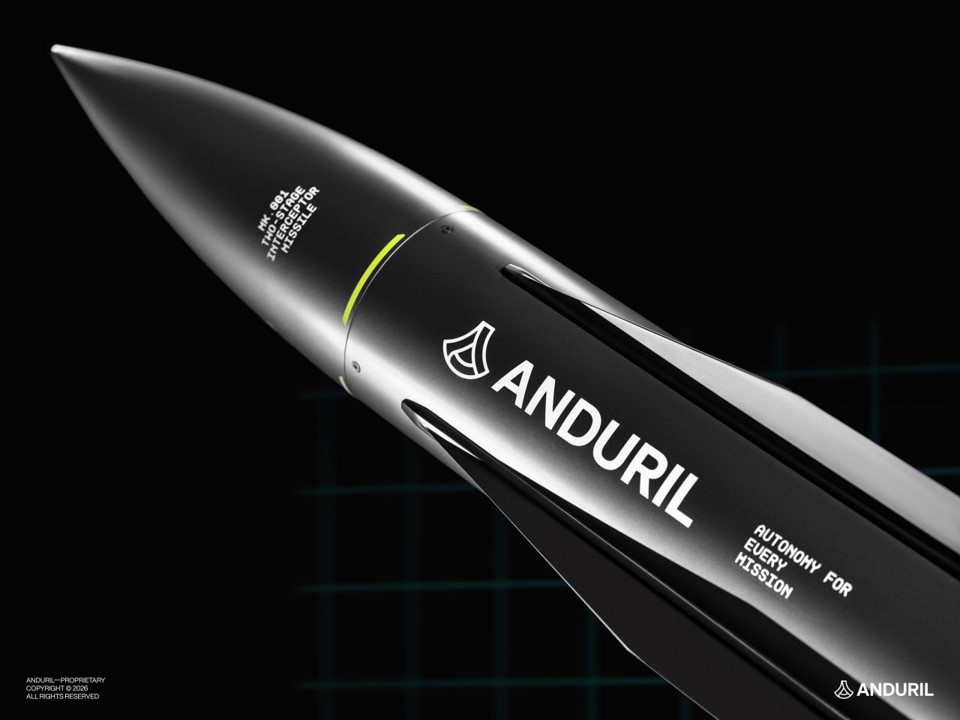
Anduril is taking a different approach to missile design, building a family of interceptors around one common core rather than starting from scratch for every mission.
Its new Steelfin family pairs different first-stage boosters with a common terminal interceptor to counter threats ranging from cruise missiles to hypersonic weapons.
The two-stage architecture allows the first stage to accommodate different solid rocket motors, adjusting range and performance while supporting different launch systems and storage configurations.
The second stage retains a common terminal interceptor design, including its airframe, software, flight control system, and interfaces.
Modular interfaces across the missile’s subsystems also allow different seekers, mission systems, and other components to be integrated without redesigning the entire weapon.
Steelfin is designed to work with land- and sea-based launch infrastructure, including the M903A2 launcher, Mk 41 Vertical Launch System, Typhon, and other containerized launch systems.
It also supports integration with fire control software systems such as AEGIS and the Integrated Battle Command System (IBCS).
Countering Evolving Threats
Steelfin’s modular approach comes as militaries face a growing range of aerial threats, from low-cost drones to ballistic missiles and maneuvering hypersonic weapons.
Air defense batteries can be forced to expend expensive interceptors against cheaper offensive weapons, potentially leaving fewer advanced weapons available for more demanding threats.
Anduril aims to address this challenge with an interceptor family developed through years of joint investment with customers.
Its common-core design is intended to offer different performance options while retaining shared components and systems.
Scaling Production
The company said Steelfin can be manufactured on a shared production line using the same equipment, workforce, and facilities across its different variants.
Anduril aims to produce several thousand interceptor missile variants annually in the near term, with capacity to scale output as demand grows.
Following ballistic testing with representative air vehicles, Steelfin is slated for flight testing in 2027.