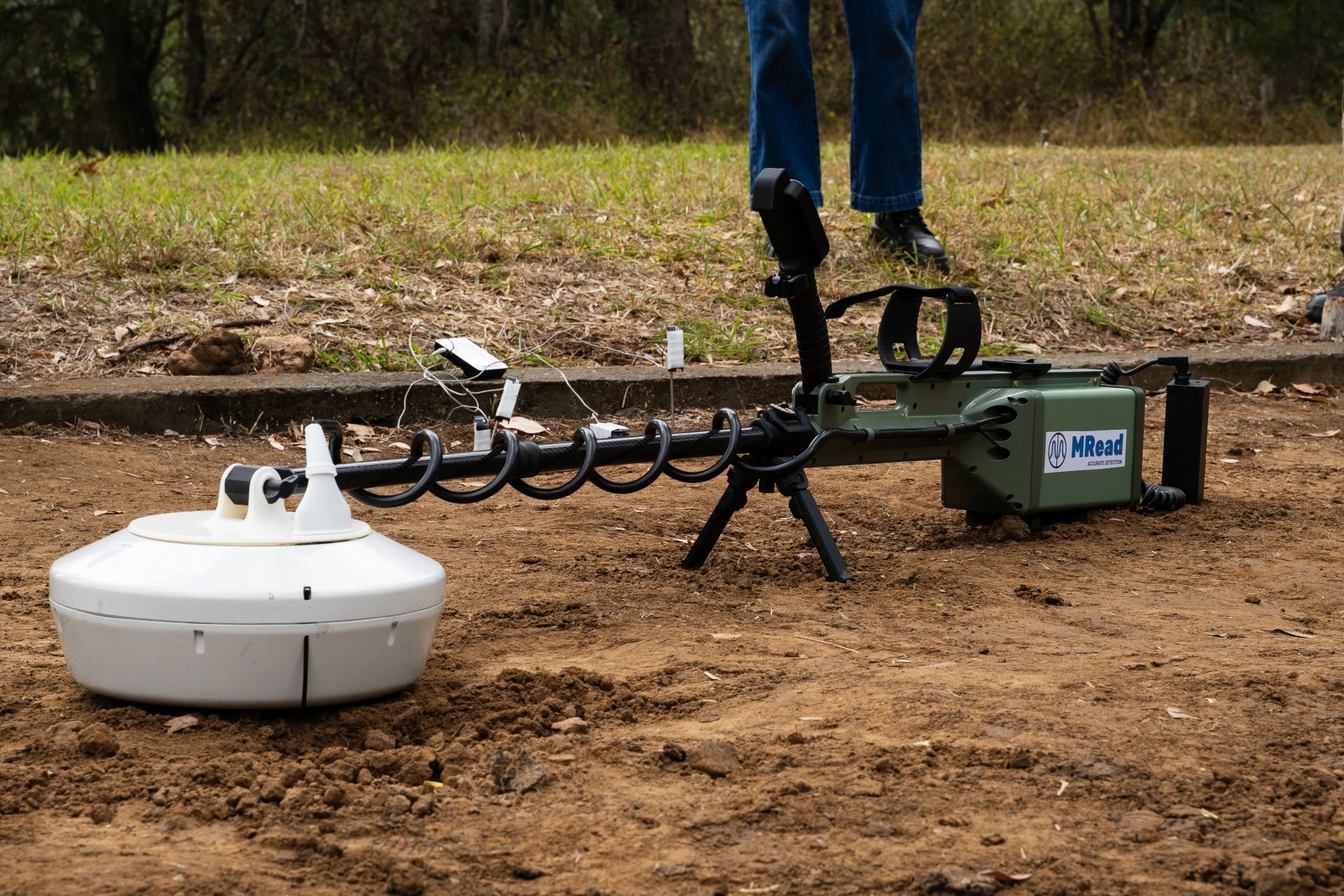

A new mine detector tested in Brisbane, Australia, takes a different approach to finding landmines by detecting the explosive compound itself rather than relying on the mine’s casing or metallic components.
Called “MineReader RDX,” the system developed by deep-tech firm MRead is designed to watch for the distinct signature of RDX, a commonly used military explosive.
It uses magnetic resonance technology to detect radio-frequency signals generated by nitrogen atoms in the explosive, allowing the system to identify RDX directly.
MineReader can detect as little as 50 grams (1.8 ounces) of RDX buried up to 13 centimeters (5 inches) underground. According to the company, it can also detect the explosive in wet ground containing metal debris and organic residue.

MRead is developing an upgrade that would enable MineReader to detect Trinitrotoluene (TNT) as well, potentially expanding its ability to identify more than 905 types of landmines.
“The capability we are ultimately developing is to take the soldier out of the threat area,” said MRead CEO John Shanahan, as quoted by New Atlas.
“Combining direct explosives detection with unmanned ground systems will allow a suspected threat to be interrogated remotely, giving commanders greater confidence about what is ahead before personnel or vehicles move through an area.”
Solving a Modern Issue
Conventional metal detectors can struggle to identify plastic landmines because they contain little or no metal. They can also produce false positives when they encounter unrelated metallic objects.
Other mine-detection technologies exist, but some are bulky or are designed to detect explosives in larger quantities.
MRead said MineReader offers a portable alternative that can detect smaller amounts of explosives directly, potentially helping military forces locate mines that conventional methods may miss.