

Defense firm Powerus has introduced the third generation of its Guardian counter-drone interceptor, now built as a fully autonomous system.
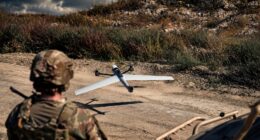
Named Guardian-3, the interceptor is designed to take off vertically and hover once an operator authorizes launch.
It then transitions into nose-first cruise flight on its own, requiring no further pilot input to fly.
A GPS receiver mounted on a camera gimbal helps keep the antenna pointed skyward during the transition.
Meanwhile, a built-in cooling channel prevents the Guardian-3’s motor electronics from overheating during both hovering and forward flight.

Powerus said the interceptor’s design is engineered to detect and prevent defects before they cause major damage.
“Built for protection. Built for speed. Built for the fight,” the company stated on social media.
Public Debut
The Guardian-3 was unveiled at the 2026 Association of the US Army’s Annual Meeting and Exposition in Washington, DC.
Powerus plans to share further technical details, including availability to industry partners, at a later date.
“Every generation of Guardian has taken more of the load off the operator. Guardian-3 is the next step, and we’re glad to show people where it’s headed,” said Powerus President and Co-Founder Brett Velicovich.