

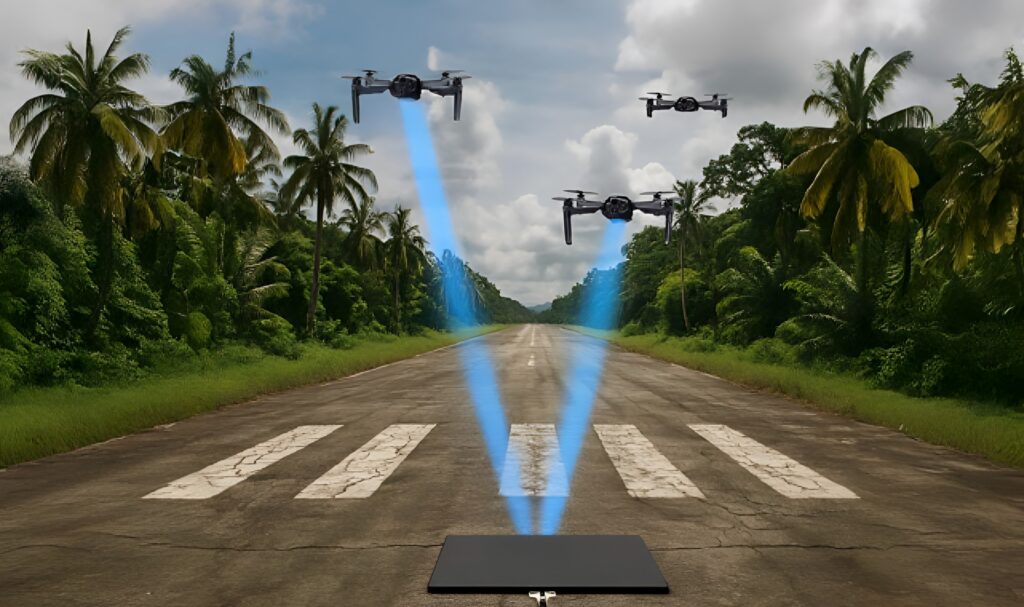
Perched drones could soon remain on station longer without returning to base to recharge, thanks to a wireless power-beaming system being explored by US startup Reach Power and the University of Nebraska-Lincoln (UNL).
The two organizations have launched a research collaboration to evaluate whether the technology can extend the endurance of perched drones conducting intelligence, surveillance, and reconnaissance (ISR) missions.
Beyond ISR, the effort will also examine how the drones could serve as persistent, reconfigurable communications and sensing nodes, according to Reach Power.
If successful, the technology could reduce battery swaps and recovery cycles that often limit endurance and situational awareness on the battlefield.
“This project brings together Reach’s wireless power-beaming expertise with the University of Nebraska-Lincoln NIMBUS Lab research capabilities in autonomous systems, communications, and field robotics,” said Dr. Brittany Duncan, director of the university’s NIMBUS Lab.
“The work is well aligned with NIMBUS Lab’s commitment to advancing practical technologies that support national security, fundamental science, and operational resilience.”
Research Backed by Air Force Program
The Department of the Air Force is funding the project through its Open Topic Small Business Innovation Research/Small Business Technology Transfer program, which aims to accelerate the adoption of commercial technologies for defense applications.
Under the program, Phase I awards support early-stage research to determine whether a technology is technically viable before advancing to prototype development.
“We are excited to work with UNL and AFWERX to advance a concept that could help the warfighter maintain connectivity and awareness in contested environments,” said Chris Davlantes, founder and chief executive officer of Reach Power.
Previous efforts have examined wireless power beaming for aerial drones, aiming to keep them airborne for longer missions.