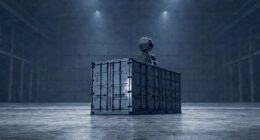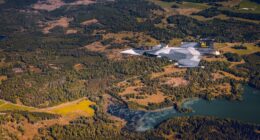

Colorado-based Radia Inc. is reimagining its WindRunner cargo plane to also airlift fighter jets and Apache helicopters for US military forces.
The newly unveiled WindRunner for Defense concept is reportedly optimized for both volume and weight, offering heavy-lift capability to rugged locations as part of the Pentagon’s Agile Combat Employment (ACE) approach.
“Strategic mobility buys time and space for the force,” said Radia founder Mark Lundstrom, adding that the platform is “designed to move full systems without disassembly and slowing operations.”

“We’re not replacing the legends that have carried the load for decades; we’re reinforcing them with a commercially fielded capability that can surge when and where commanders need it, for ministries of defense worldwide.”
Comparison Against Modern Standards
According to Radia, moving equipment with modern military airlifters such as the C-5 Galaxy and C-17 Globemaster III often requires full disassembly and rerouting.
This process can hamper operational timelines and make valuable assets more vulnerable to ambush attacks.
With the WindRunner for Defense, mission-ready loads like F-35s and Chinooks can be transported without the need for aerial refueling. The plane can reportedly haul four F-35s or 12 Apaches — seven times the volume of a C-5, twelve times that of a C-17.
The aircraft is also fully compatible with standard ground equipment, eliminating the need for specialized loaders.
Compared with current airlifters, which may take days to prepare large-scale deployments, WindRunner can be ready “within hours,” significantly speeding up military transport operations.
‘World’s Largest Plane’
The standard WindRunner variant has a wingspan of over 261 feet (80 meters) and a length of roughly 356 feet (109 meters), making it larger than the Soviet-built An-225 Mriya, previously the world’s largest plane before its destruction during Russia’s war in Ukraine.
Despite its massive size, Radia said the plane can take off and land on rough airstrips as short as 6,000 feet (1,800 meters). It can also travel at speeds of Mach 0.6 (741 kilometers/460 miles per hour) with a range of 2,000 kilometers (1,200 miles) at maximum payload.
“The world developed ground infrastructure years ago based on ordinary needs, but we are now living in extraordinary times and ground transportation hasn’t kept up,” the company stated on its website.
The WindRunner for Defense is projected to take flight by 2030, with Radia planning to use market-available parts to simplify certification.