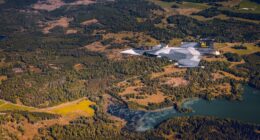
Incheon-based Pablo Air has officially entered the defense arena with a suicide drone built to hunt tanks using one-kilogram (2.2-pound) warheads.
Called S10s, the drone can coordinate for a “salvo strike,” where multiple units attack a single target either at once or in quick, timed succession.
The S10s can fly for 30 minutes at speeds of up to 150 kilometers (93 miles) per hour, covering an operating range of 38 kilometers (24 miles).
Its modular frame lets operators quickly swap out mission equipment, and its ammunition rail system supports various front modules, including first-person view setups, night vision sensors, and basic camera units.

Pablo Air said the drone strikes at a 45-degree angle, yielding a more explosive force compared to other anti-tank drones that only strike at a 20-degree angle or less.
“Constructed using foam board material that is easy to source and handle, [S10s] is designed for simple assembly and rapid large-scale production,” the company stated.
A ‘Necessary’ Development
The new drone’s emergence comes as tensions stay high on the Korean Peninsula, with both Koreas ramping up defenses in case of a conflict.
Earlier this year, Pyongyang tested its AI-enabled reconnaissance and suicide drones, reportedly developed with Russian support.
Pablo Air’s move into defense underscores South Korea’s growing push for homegrown, low-cost unmanned systems capable of matching regional threats.
Beyond the S10s, the company is developing a range of autonomous platforms for surveillance and reconnaissance.
Production timeline for the S10s remains unclear, but each drone is reportedly valued at roughly 6 million Korean won ($4,252).