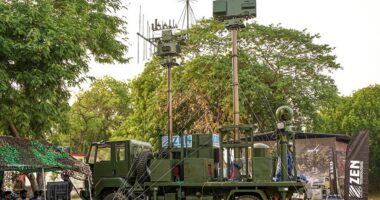

US firm Ondas Sentinel is pushing its counter-drone defenses farther out with a new system designed to disrupt airborne threats before they get too close.
Called REACH, the counter-unmanned aerial system (C-UAS) trades an interceptor-first approach for command-and-control (C2) disruption, Global Navigation Satellite System denial, and optional Positioning, Navigation, and Timing electronic attack.
Designed to work as part of a layered defense, REACH can tackle drones while they are still beyond the range of handheld countermeasures.
The system brings the detection and engagement process together through a single interface, pairing the company’s Detect, Track, and Identify systems for target cueing with its DefenseOS open C2 software.

If electronic effects fail to neutralize a threat, the same architecture can hand the target over to a kinetic interceptor for further engagement.
“Operators keep telling us the same thing: by the time a drone is inside handheld range, they have already lost time they cannot get back,” said Ryan Hartman, president and chief executive officer of Ondas Sentinel.
“REACH pushes the engagement out, gives them room to make a decision, and does it with a system our customers already know how to use.”
REACH at a Glance
REACH has an estimated disruption range of 10 kilometers (6.2 miles), with 360-degree coverage and remote operation through C2 integration.

Operators can reportedly enable or disable individual frequency bands, adjust their power levels, and set each band’s start and stop frequencies.
The system uses directional radio-frequency (RF) signals to focus electronic energy on specific targets, helping limit unwanted effects on nearby areas.
REACH can also support missions beyond the battlefield, including protecting critical infrastructure, securing borders and perimeters, and safeguarding events and venues.