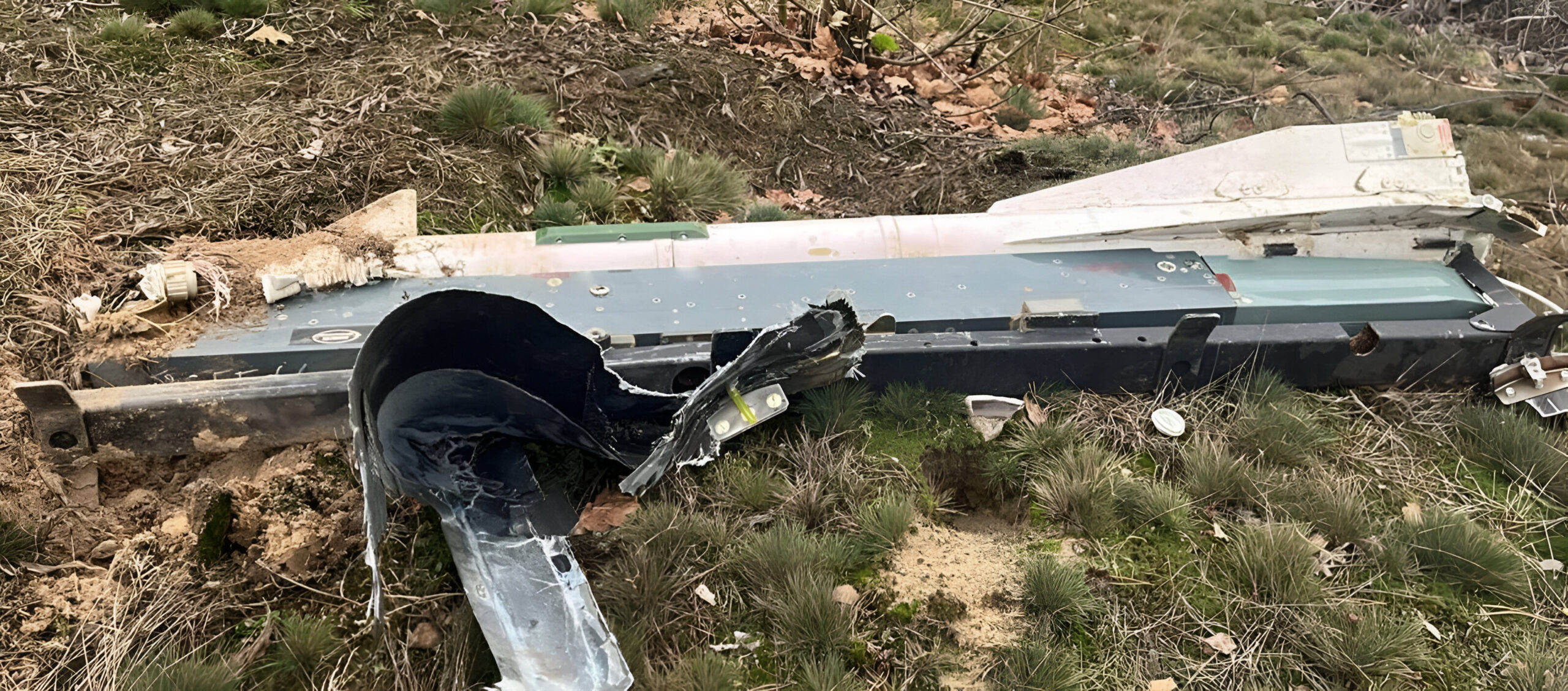

A Russian Geran-2 unmanned aerial vehicle (UAV) fitted with an unconventional payload has surfaced in Ukraine, prompting Kyiv’s Main Intelligence Directorate (HUR) to release new details about the modified platform.
Instead of acting as a kamikaze drone, the UAV appears to have been reconfigured to carry a Soviet-era R-60 air-to-air missile, suggesting a role aimed at targeting Ukrainian helicopters and aircraft involved in drone interception.
The missile is mounted on a custom bracket atop the drone’s fuselage, while two network cameras installed on the nose are believed to provide operators with visual cues for aerial target detection.

A Chinese mesh modem handles video transmission and control commands, while most of the flight control and navigation hardware remains unchanged from standard Geran-2 configurations.
To counter electronic warfare, the drone is equipped with a 12-channel Kometa module designed to improve resistance to jamming.
Inside, the HUR also identified a Raspberry Pi microcomputer, a tracking unit, and two GSM modems used for telemetry transmission.
Operational Concept
According to HUR assessments, operators could rely on the forward‑mounted cameras to visually identify airborne targets before cueing the R‑60 missile, which uses infrared homing to lock onto a hostile aircraft.

“The main purpose of the new development is to create a threat to the Ukrainian army and tactical aviation, reduce the effectiveness of its work with intercepting enemies [using drones,]” the HUR stated in a social media post.
The new setup suggests Russia may be experimenting with a reusable Geran-2 variant, shifting the platform away from its traditional expendable role and toward a more flexible, air‑denial function.