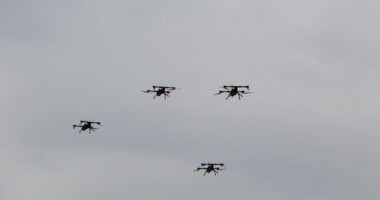


Counter-drone defense often depends on disrupting a hostile aircraft’s communications or navigation, but that approach has limitations against drones that operate autonomously or use fiber-optic control.
ParaZero Technologies is taking a different route with TillOnAIR, a new counter-drone solution that uses ground-based detection and guidance to direct a reusable interceptor toward incoming threats.
It combines a ground control unit, a quadcopter interceptor, and the company’s DefendAir net launcher in an autonomous setup designed to detect, engage, and physically capture hostile drones.
ParaZero said the system can provide a configurable protection radius of 50 to 100 meters (164 to 328 feet) around defended sites.
Keeping Detection on the Ground
Unlike systems that rely on onboard sensors to find and track targets, TillOnAIR handles those functions from its ground station, which guides the interceptor toward the approaching drone.
This arrangement means the interceptor does not need its own GPS, camera, homing seeker, or beacon receiver, allowing ParaZero to use a simpler and lighter aircraft.

The system then directs the interceptor above the target, where it deploys a net designed to capture the hostile drone without using an explosive warhead.
That physical approach could prove useful against fiber-optic-guided and autonomous drones, which may not be vulnerable to conventional jamming because they do not depend on a standard radio link.
Built for Repeated Engagements
TillOnAIR’s interceptor is designed to return intact after an engagement, with the net pod serving as the only component that needs replacing before another deployment.
The reusable design could help reduce the recurring cost of countering repeated drone incursions, particularly at locations that require continuous protection.
ParaZero said the roughly 15-kilogram (33-pound) system can be set up in about 20 minutes, making it suitable for temporary military positions as well as permanent installations.
One ground station can also coordinate multiple interceptors against incoming threats, while its architecture is designed to remain resilient in environments affected by electronic interference.
The company plans to demonstrate TillOnAIR to military, government, and security organizations in Israel in November before taking the system to international demonstrations.