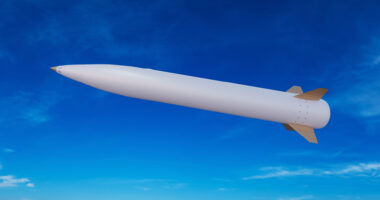


Lockheed Martin just took the Joint-Air-to-Ground Missile (JAGM) Quad Launcher (JQL) a big step closer to battlefield reality, proving it can fire missiles straight up, then quickly strike an incoming drone.
In the latest test, the system moved from the previous 45-degree launch angle to a full 90-degree vertical launch, marking a significant capability jump.
It was mounted on a Richard Childress Racing 6×6 Mothership vehicle and successfully neutralized an unmanned aerial system (UAS), underscoring its counter-drone relevance.

Conducted at China Lake, California, the engagement also demonstrated the missile’s ability to detect and track drones and other aerial threats.
“The successful JQL vertical‑launch demonstration confirms that JAGM can be rapidly deployed from a multi-missile launcher across a variety of scenarios,” said Casey Walsh, program management director of Lockheed Multi-Domain Missile Systems.
“This milestone validates our vision of a unified missile architecture that seamlessly operates across air, land, and sea domains, enhancing survivability for future combat operations.”
Strategic Impact
The demonstration validated JAGM’s vertical-launch capability across multiple platforms, including surface combatants, expanding 360-degree defensive coverage.
The integration of JAGM with the JQL also shows adaptability across air, sea, and land environments, giving operators flexibility to adjust engagement options.

With its dual-mode seeker using semi-active laser and millimeter-wave guidance, the integration positions the missile as a viable munition option for the US Navy and allied forces.
“Lockheed Martin continues to push the boundaries of what is possible in vertical launch system development, driving innovation and advancement in the field,” said Edward Dobeck, director of Lockheed Martin Launching Systems business area.
“This proven combat-ready capability meets multidomain deployment objectives today, and provides the same reliability expected of all our launching systems.”