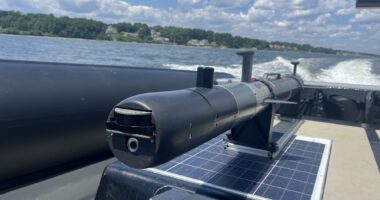

EUROATLAS is raising the bar for underwater autonomy with two new Greyshark drone submarines: a short-range, battery-powered variant and a hydrogen-fueled model that can roam the depths for 16 weeks straight.
Foxtrot, fitted with a hydrogen powertrain, can travel up to 11,000 nautical miles (12,659 miles/20,372 kilometers) at four knots (4.6 miles/7.4 kilometers per hour) — all without tethers or data links.
Bravo, with a battery engine, has a shorter range but retains the same sensor suite and data-collection capabilities as its sister variant, allowing it to take on the same types of missions.
Both autonomous underwater vehicles (AUVs) boast level 5 autonomy, meaning they can operate under any conditions without a human stepping in for control.
Beyond individual operation, Bravo and Foxtrot can swarm together through “mothership control,” coordinating with surface ships and land units via EUROATLAS’ combat cloud tech.
They can also be deployed from aerial, naval, or coastal platforms and return autonomously to recharge.
Continuous Info Collection
Both Greyshark variants carry a total of 17 sensors that collect data continuously during missions.
They can navigate open water via GPS, map Arctic seabeds, and execute missions even in GNSS-denied environments.
This gives military forces flexible and persistent naval intelligence, allowing data to flow without personnel leaving their posts.

“In a changing world, global affairs are contested on multiple fronts,” EUROATLAS Chief Executive Officer Eugene Ciemnyjewski stated in a press release.
“EUROATLAS responds to such challenges with Greyshark: a force multiplier that offers elevated protection across maritime operations.”
What’s Next?
The Greyshark Bravo is moving toward production after sea trials, while the long-endurance Foxtrot is set to undergo testing later this year following hydrogen fuel cell integration.
EUROATLAS plans to increase production capacity to 150 Greyshark units per year by 2026.
“With a deep network and trusted partners, EUROATLAS can scale production to enhance autonomous underwater capabilities across NATO and partner nations at an accelerated rate,” Ciemnyjewski added.