
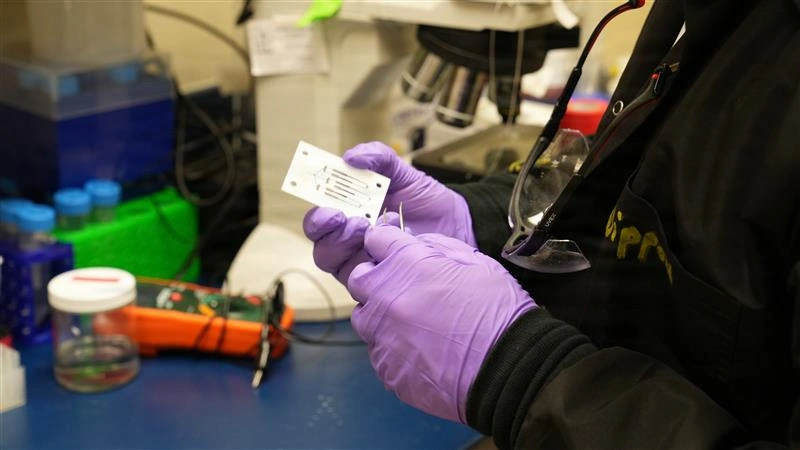

Scientists at the US Army Research Laboratory (ARL) have invented a new tool aimed at accelerating the discovery of binding agents for next-gen military technologies.
The kappa(k)Chip system is a microfluidic device that screens proteins for binding properties relevant to a range of military applications.
These binding agents are molecules that act like highly selective “connectors,” attaching to specific targets such as chemicals, pathogens, or materials, and enabling functions like sensing, detection, or repair in defense systems.
The kappa(K)Chip can analyze billions of protein interactions in parallel, significantly cutting down a process that traditionally takes much longer and incurs higher costs.
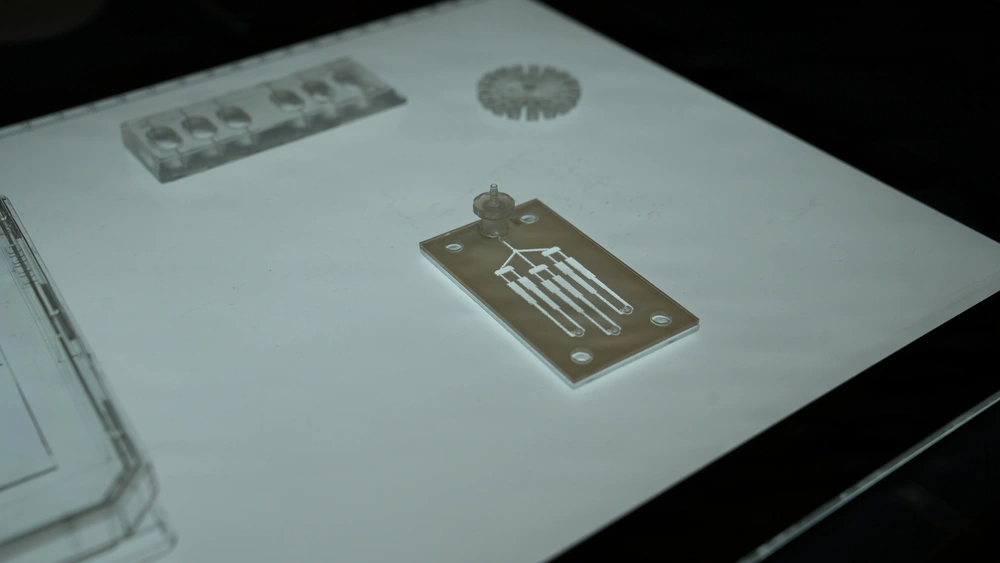
According to ARL, the system is up to 24 times faster and 200 times more cost-efficient than conventional methods, potentially allowing researchers to complete “one month’s worth of experiments in one day.”
The platform is paired with a software tool that uses artificial intelligence to analyze large volumes of image-based experimental data.
“Nothing like this device exists right now,” said Dr. Jose Wippold, ARL bioengineer and co-inventor.
“The kappa(k)Chip will make it much easier for researchers to find proteins and novel binding agents, especially those that meet specific Army requirements and conditions that industry doesn’t provide.”
Made Possible by Interns
Three student interns helped refine the kappa(k)Chip and its workflow over three years through the National Security Scholars Summer Internship Program.
Wippold said the project provided a hands-on example of how the US Army approaches complex technical challenges while helping train the next generation of researchers.
“The interns in my team all worked hard in the lab and played a big part in the experimentation,” he said. “Through this work, they gained first-hand experience and knowledge of best-in-class defense research.”