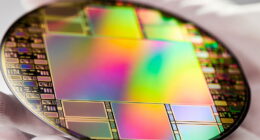


Northrop Grumman is tackling a major challenge in modern radio frequency (RF) systems: moving massive amounts of information quickly, cleanly, and reliably.
The company’s answer is FORTITUDE, a grain-of-rice-sized gallium nitride (GaN) microchip with unique circuitry that triples power output and boosts signal quality by 20 times.
Previously known as the Super Lattice Castellated Field Effect Transistor, the technology could help satellites, radar, GPS, electronic warfare, and future 6G systems move more data while maintaining reliable connections.

Building on Northrop Grumman’s microelectronics research and investment, FORTITUDE could also replace dozens of components, reducing system weight and power consumption.
“At Northrop Grumman, we’re passionate about pushing the limits of what our microelectronics can do for our customers and the nation,” said David Shahin, advanced packaging lead for the Northrop Grumman Microelectronics Center.
“FORTITUDE is our latest example of how we’re shaping the future of… connectivity and resilience across critical commercial and defense applications. And it’s made in America, in our secure, onshore microelectronics facilities.”
A Closer Look at FORTITUDE
FORTITUDE comes in medium- and high-power models and uses a multilayer architecture with up to 10 signal-channel layers to increase data throughput.

The chip supports frequencies ranging from kilohertz (kHz) to 20 gigahertz (GHz), allowing a single device to work across multiple radar and communications bands.
Its tenfold higher electron density also enables greater power efficiency and sub-nanosecond switching speeds compared with conventional chips.
As wireless standards move toward frequencies beyond 6 GHz, the technology could help reduce costly redesigns for next-generation radar, communications, and other RF systems.