

Japan is ramping up its directed-energy efforts, sending a 100-kilowatt-class laser weapon to sea for its first real-world trials.
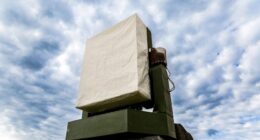
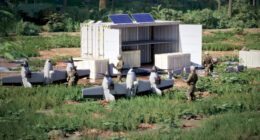
The system, which boasts a domestically produced fiber-laser architecture, arrived at Japan Marine United’s shipyard in two 40-foot (12-meter) container-sized modules.
It merges 10 fiber lasers, each rated at 10 kilowatts, into a single 100-kilowatt beam capable of cutting through metal and drone airframes.
The shift from earlier chemical-based prototypes to fiber-laser tech reportedly allows for safer operation, easier maintenance, and far greater scalability.

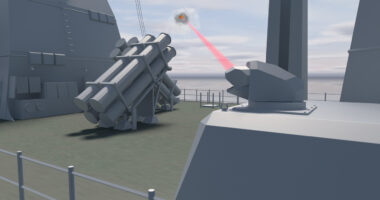
Engineers are now evaluating the system under live maritime conditions, with installation complete aboard the Japan Maritime Self-Defense Force’s Asuka ship.
Behind the Beam
Deck-mounted, the dome-shaped turret directs fast-steering mirrors, thermal imagers, and tracking sensors to stay locked on airborne threats.
The compact system includes beam-control optics, an integrated cooling system, and a dedicated power unit to sustain high-intensity operations.
Japan’s Acquisition, Technology & Logistics Agency has noted a key advantage: an almost unlimited magazine, constrained only by available power.

Next-Gen Laser Push
Upcoming tests will challenge the laser against airborne targets under maritime conditions, including moisture, sea spray, thermal distortion, and ship motion.
The team is also evaluating detection, tracking, and engagement capabilities across ranges and altitudes as part of a layered naval defense setup.
Next year, testing is expected to expand to high-speed projectiles, moving the weapon closer to counter-rocket, artillery, and mortar roles.
While integrating fiber lasers into Tokyo’s broader missile-defense network is a long-term goal, officials cautioned that operational deployment is still several years away.