
US firm Hall Lidar Inc. is pushing drone detection into 3D situational awareness with the UDL-64 (Ultimate Drone Listener), an AI-powered sensing system that builds a spatial view of drone activity from sound.
Lightweight by design, the tech measures approximately 24 inches (61 centimeters) in diameter, allowing it to be quickly deployed across a range of mission settings.
It features integrated Wi-Fi, Bluetooth, and 5G connectivity, making it easy to slot into broader command-and-control networks.
The system operates without reliance on radio frequency emissions or GPS, and remains fully passive and invisible to adversary sensors as it produces no signals.
It can be mounted on a tripod or mast and deployed within minutes, supporting both mobile units and fixed-site defense roles.
In standalone mode, the UDL-64 detects drones at ranges of up to 200 meters (656 feet) and increases to 500 meters (1,640 feet) when operating in a networked configuration.
Turning Sound Into Target Data
The system uses a high-density microphone array and AI processing to capture spatial audio and apply real-time beamforming for tracking aerial threats across defined zones.
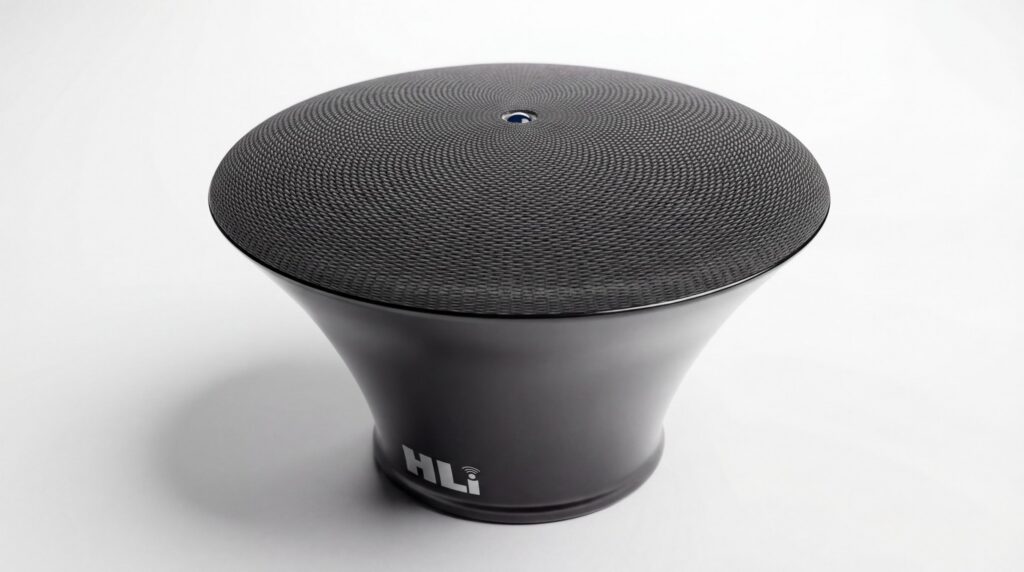
It then applies trained acoustic models to identify drones by their rotor signatures, filtering them from background noise such as wind and urban activity.
In networked deployments, multiple units can be linked to triangulate targets, enabling full 3D tracking across wider coverage areas.
An optional optical module can be added to provide an additional sensing layer while remaining low-profile.
Bridging the Gap
Hall Lidar said the system is designed to address evolving drone threats by operating in environments where traditional detection systems face limitations.
The UDL-64 is engineered and manufactured in the US, which the company said supports supply chain transparency and procurement requirements.
Chief Executive Officer and Head Scientist David Hall said the device was designed to be cost-effective while remaining adaptable to different operational needs.
“Customers should not have to choose between performance and security,” Hall stressed. “We’ve built a system that delivers both advanced AI-based acoustic detection with the assurance of American manufacturing and supply chain integrity.”