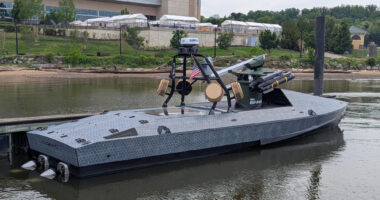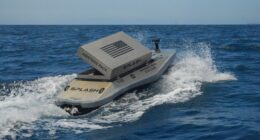


Teledyne FLIR Marine is aiming to give uncrewed surface vessels (USVs) a sharper view of their surroundings with a multispectral camera built to detect, identify, and track objects in harsh sea conditions.
Named the FLIR M364C-USV, the device pairs a 640 × 512 thermal imager with a full high-definition camera featuring 30× optical zoom.
A longer-range variant, the M364C LR-USV, offers a narrower field of view suited to larger, more stable vessels requiring extended-range performance, while the standard M364C-USV’s wider field of view fits most vessel applications.

It features Ethernet control, embedded telemetry, standardized network support, and synchronized video and sensor data for AI, machine vision, and autonomy applications.
According to the company, it leverages enhanced stabilization to support imagery during vessel motion and active pan-and-tilt movement.
Engineered for low-latency command and control, the system delivers frame-aligned video and metadata to enable real-time sensor fusion and automated decision-making.

“Autonomous and uncrewed vessels depend on reliable sensing technologies to operate safely and effectively in dynamic maritime environments,” said Michelle Hildyard, general manager of Teledyne FLIR Marine.
“The M364C-USV delivers the real-time visibility and situational awareness operators need to make better decisions, avoid hazards, and support mission success, while providing the durability required for continuous operation at sea.”
Expanding Maritime Sensing
The M364C-USV reportedly provides the clear, actionable imagery needed for navigation, obstacle avoidance, surveillance, security, and environmental monitoring.
Marine Video Analytics further adds object-detection capabilities, allowing the camera to identify non-water objects such as boats, buoys, and floating debris.

A separate Color Thermal Vision feature blends the thermal and low-light visible cameras to help operators identify color details such as navigational lights and aids.
To support fast-track deployment, the M364C-USV simplifies integration with autonomy, remote-control, and mission-management systems.
By combining thermal and visible imaging, the camera can also operate day and night, including in environments affected by glare and light fog.
By the Numbers
The camera weighs 13.9 pounds (6.3 kilograms), draws 41 watts of power under nominal conditions, and is rated IPX6 for water ingress, with an operating temperature range of -13 to 131 degrees Fahrenheit (-25 to 55 degrees Celsius).
For detection performance, the company said the M364C-USV can spot a 30-foot (9-meter) vessel at up to 3.2 nautical miles (3.7 miles/5.9 kilometers) and identify a human-sized target at roughly 0.39 nautical miles (2,370 foot/725 meters).