Israeli firm DSIT Solutions is stitching together multiple layers of underwater surveillance with a new Underwater Domain Awareness (UDA) concept designed to track threats beneath the surface.
At its core, the concept uses a layered architecture that fuses short-, medium-, and long-range sensing platforms into a unified command-and-control network.
The goal is to deliver a continuous, AI-assisted underwater operational picture for naval operators protecting ports, straits, and offshore assets.
The concept is aimed at countering hostile submarines, unmanned underwater vehicles, diver propulsion vehicles, and combat divers.

“The underwater domain is facing a rapidly increasing number of advanced unmanned underwater threats,” said Amir Alon, vice president of marketing and business development at DSIT.
“Our UDA solution gives a response to these growing challenges — delivering continuous, long-range, layered detection that enables comprehensive underwater control.”
The company showcased the UDA concept during the Combined Naval Event 2026 in Farnborough, UK.
Core Components
The UDA framework divides detection into multiple security layers, with each tier reportedly providing increasingly detailed tracking as a target moves closer to protected waters.
The outer layer is anchored by SeaShield, a fixed low-frequency sonar system that operates in both active and passive modes and is designed for automatic detection and tracking through advanced acoustic processing.

The mid-range layer relies on BlueShield, a seabed-mounted sonar derived from DSIT’s BlackFish Hull Mounted Sonar.
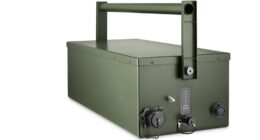
For close-in monitoring, the company employs the AquaShield Diver Detection Sonar and PointShield Portable Diver Detection Sonar.
Both systems feature automated detection capabilities that require minimal operator intervention while aiming to maintain low false-alarm rates and high sensitivity to potential threats.