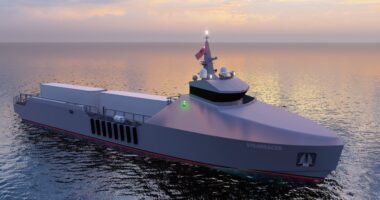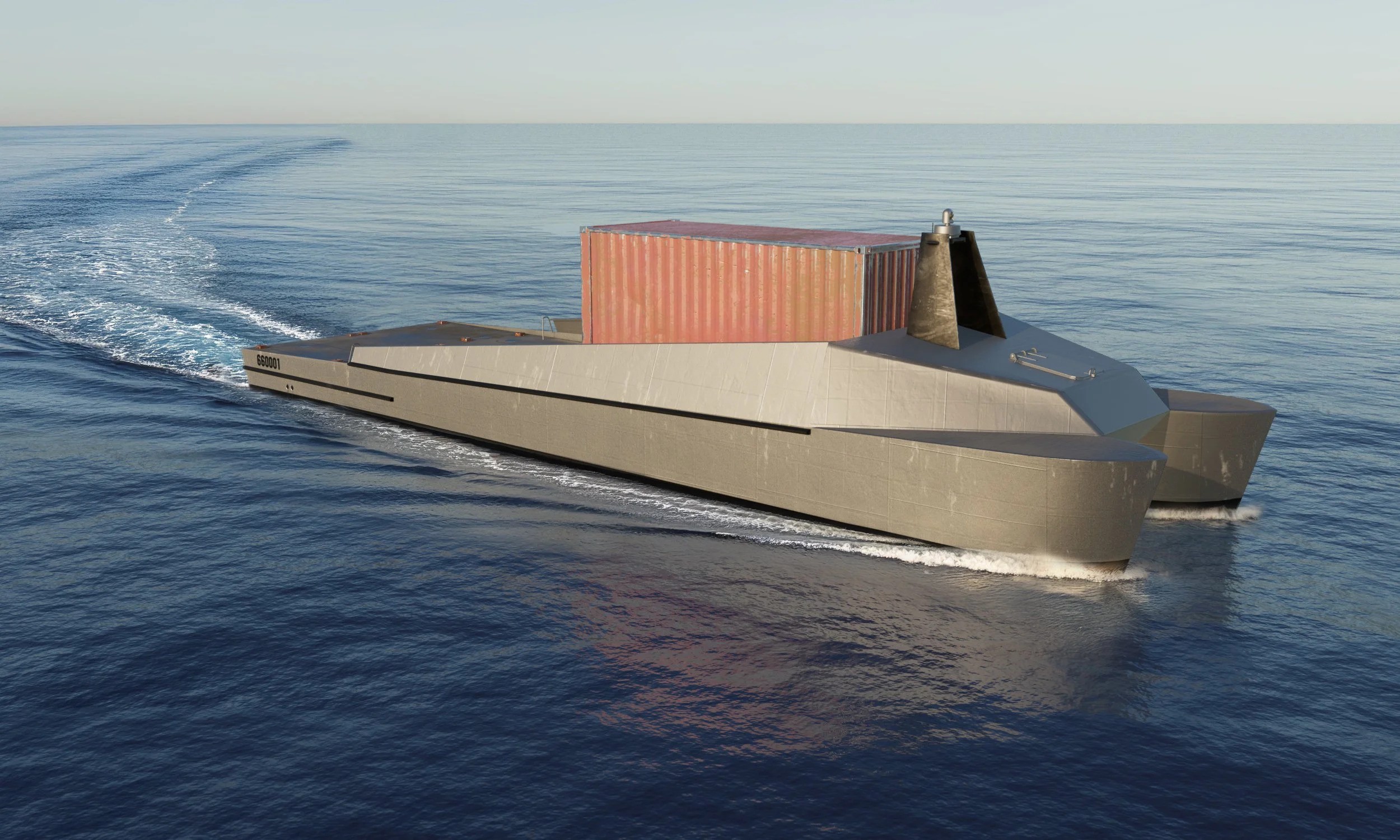
BlackSea Technologies has announced the development of its Modular Attack Surface Craft (MASC), a new family of unmanned surface vessels (USV) built to meet the US Navy’s push for modular, multi-mission combatants.
Unlike commercial hulls adapted for military use, the MASC was designed from the keel up to maximize payload access and flexibility. It can carry more than 67,000 pounds (28,122 kilograms) of payload, doubling the capacity of comparable craft.
The vessel also has 900 square feet (84 square meters) of open deck space and 198 kilowatts of electrical power to support the integration of advanced sensors and weapons.

Despite the heavy payload capacity, the craft can maintain a top speed of 25 knots (46 kilometers/29 miles per hour) with an operational range of 3,000 nautical miles (3,452 miles/5,556 kilometers).
It also boasts a self-deploying endurance of up to 10,000 nautical miles (11,507 miles/18,520 kilometers).
The MASC is engineered to support seven mission profiles, including anti-submarine warfare, anti-surface warfare, intelligence, surveillance and reconnaissance, and logistics.
Fleet Integration
The USV’s twin aluminum hulls, derived from BlackSea’s Global Autonomous Reconnaissance Craft, are built for low drag and stability, allowing safer launch and recovery of containerized payloads.
Propulsion comes from dual Volvo Penta D8-IPS600 units, which simplify assembly by eliminating shaft alignment and are supported by a global logistics network.
Its open architecture runs natively on the US Navy’s Unmanned Maritime Autonomy Architecture, ensuring plug-and-play integration with autonomy systems and preventing vendor lock-in.

By consolidating the navy’s earlier Large and Medium USV efforts, the MASC project shifts toward a single modular platform focused on distributing lethality across the fleet.
Meeting US Navy Requirements
In July 2025, the US Navy issued a solicitation to industry partners for modular surface vessels capable of executing multiple missions using containerized, rapidly reconfigurable payloads.
The list of missions include anti-surface warfare, strike operations, electronic warfare, mine countermeasures, and logistics.
BlackSea said its MASC is purpose-built to go beyond those requirements, offering greater endurance, power, and payload capacity than retrofitted commercial hulls can provide.
“Fleet modernization demands bold steps,” said Chris Devine, CEO of BlackSea. “With our MASC solution, the US Navy can field a family of unmanned combatants that are mission-driven, production-ready, and built to scale.”