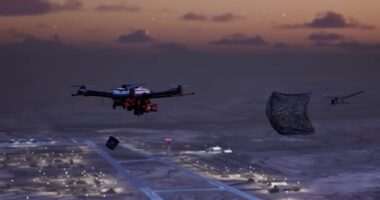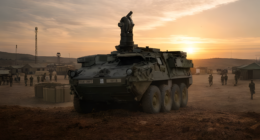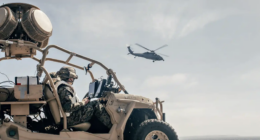


Frontline combat vehicles now have a new mobile defense option to counter evolving drone threats on the battlefield with the Iron Wasp interceptor, developed by Israel’s Rafael and SpearUAV.
Built on the VIPER I interceptor, the system is designed to launch directly from combat vehicles, giving crews an organic counter-drone capability without requiring major modifications to their platform.
Its open architecture supports a range of sensors, warheads, and mission systems, allowing operators to tailor the interceptor for different mission requirements.
The compact design also enables integration across various ground platforms, including armored fighting vehicles, armored personnel carriers, and tactical vehicles.

“Rafael’s strength has always been our ability to bring the right technologies together into a protection architecture that is greater than the sum of its parts,” said Tzvi Marmor, executive vice president and head of Rafael’s Land and Naval Systems division.
“Iron Wasp represents exactly the kind of innovation that strengthens this architecture, adding an organic aerial interception capability that our customers increasingly need.”
The system was unveiled at the Eurosatory 2026 event in Paris.
From Detection to Neutralization
Unlike traditional interceptors that rely on external launch infrastructure, Iron Wasp is fired from a compact Multi-Canister Launcher designed to minimize deployment signature.

The engagement sequence begins with radar-based target tracking, which guides the interceptor toward the threat.
Datalink updates provide course corrections during flight, while an onboard electro-optical sensor and machine-vision algorithms take over in the final phase to identify, track, and engage the target.
The Core DNA
Iron Wasp’s base platform, the VIPER I interceptor, was developed to protect vehicles and fixed installations from top-attack threats, including strike drones and loitering munitions.
The platform combines a modular architecture with AI-enabled processing, allowing it to integrate third-party sensors and warheads while detecting and tracking fast-moving aerial targets.