

Poland’s defense industry is stepping up its unmanned systems game with a new modular reconnaissance robot presented to NATO officials.
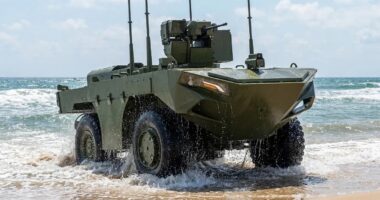
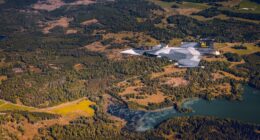
Developed by WITPiS and Chema DS, with support from Forcepol sp. z o.o., the system pairs the KUNA Unmanned Land Weapon System with the RAVEN drone for coordinated ground-air operations.
The KUNA uses Light Detection and Ranging sensors, cameras, and onboard detection systems to navigate obstacles independently and operate in terrain where wheeled systems may falter.

Lessons from the war in Ukraine have shaped its design, emphasizing sensor fusion, communications resilience, and autonomy for reconnaissance in complex environments.
The RAVEN extends the vehicle’s operational reach, providing aerial surveillance and relaying telemetry and video data between the KUNA and its operator.
This airborne link allows the ground platform to continue operating when Global Navigation Satellite System signals are jammed or terrain blocks direct control.
Built to Adapt
Chema DS said the system’s modular architecture allows operators to swap payloads to suit operational needs.
Each module is tailored to a task, carrying sensors, tools, or supplies, while a dedicated transport module allows the vehicle to haul materials, equipment, or humanitarian aid.
To speed up logistics, both the base platforms feature forklift attachment points for rapid loading and reconfiguration in the field.
In operation, the KUNA can be remotely piloted or programmed to follow pre-set routes, with both modes managed via the RAVEN drone.
The project reflects Poland’s commitment to delivering adaptable, networked robotic systems that align with NATO’s evolving approach to multi-domain operations.