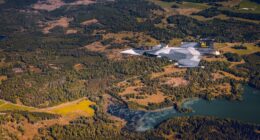
The US Air Force has awarded Firestorm Labs a $100-million contract for its small unmanned aerial systems.
The project calls for the California-based startup to deliver its flagship drones, associated support services, and research and development work for multiple applications.
Firestorm currently offers the Tempest 50, a platform manufactured through the use of proprietary 3D printers called xCell, which could enable the rapid production of drone parts at a temporary location near a warzone.
According to an update from the Pentagon, the deal will cover the integration of the drones into the US Air Force’s innovation arm AFWERX at Eglin AFB in Florida.
It will also support the Adaptive Air Enterprise, Hale Cluster, and Babbage Flock initiatives, which are military and federal projects that utilize drone swarms.
Additionally, the contract will be employed for activities related to “robotic and autonomy platforms for interoperable devices.”
Firestorm will run associated works in San Diego, with an expected completion date of December 2031.
Firestorm’s Tempest 50
The Tempest 50 weighs less than 55 pounds (25 kilograms), has an airframe length of 6 feet (1.8 meters) and a wingspan of 7 feet (2.1 meters).
It is designed to transport up to 10 pounds (4.5 kilograms) of cargo including standard payloads and explosives.
Firestorm claims that the modular and open-architecture drone costs about one-fifth of the production value and about one-tenth the time to build compared to existing fixed-wing systems with similar specifications.
In the field, the aircraft can deploy for up to 36 hours.
Recent Milestones
Firestorm secured $12.5 million in initial seed funding last year from a Lockheed Martin-led consortium to expand the startup’s projects, particularly in its expeditionary 3D specialty.
In an interview with the San Diego Business Journal, Firestorm CEO Dan Magy revealed that the firm will move its operations from its existing 15,000-square-foot (1,394-square-meter) center south of Marine Corps Air Station Miramar in San Diego to a 35,000-square-foot (3,252-square-meter) space on the northern section of the base.
The company is also working on a second unmanned aerial system called El Niño that has a smaller airframe compared to the Tempest.