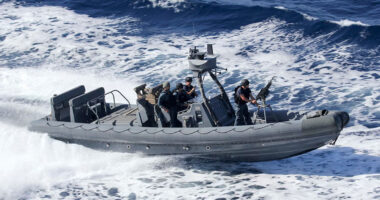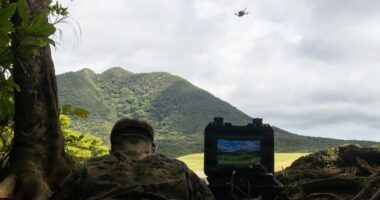
AeroVironment is putting battlefield command at soldiers’ fingertips with the new Grip TA5, a tablet-based tactical controller built to sharpen awareness, enable precision strikes, and adapt to any mission.
Weighing just 2.5 pounds (1.13 kilograms), the rugged device pairs with the Samsung Tab Active5 Tactical Edition, turning a commercial tablet into a mobile command hub.
Its modular, multi-platform setup lets operators direct multiple robotic assets in real time, whether for intelligence, surveillance, reconnaissance, target acquisition, fire control, or even direct operation of lethal payloads.
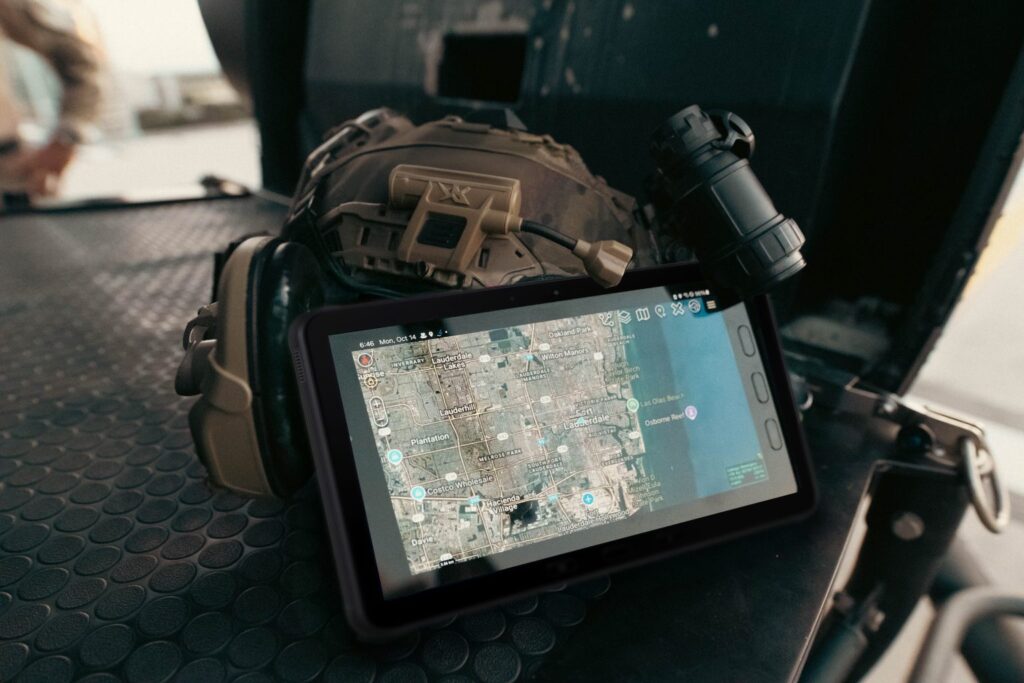
The TA5 adds upgraded networking, stronger software security, hot-swapping for quick battery changes, and an expandable port for dual displays.
Built to MIL-STD-810 standards, the device delivers more screen space without losing portability. The developer said it was also shaped by soldier feedback.
“Our ability to deliver effective, next-generation solutions at mission scale and speed positions AV (AeroVironment) as a top developer and manufacturer in the defense industry,” noted Trace Stevenson, President of Autonomous Systems at AeroVironment.
“The Grip TA5 is more than a controller. It’s a force multiplier that brings speed, interoperability, and future-ready capabilities to the modern warfighter.”
Army and Marine Corps Integration
Earlier this year, the US Army Rapid Capabilities and Critical Technologies Office awarded AeroVironment $5.1 million to advance human-machine teaming under the Human-Machine Integrated Formations prototyping project.

As part of that effort, the TA5 was chosen as the service’s dismounted common controller.
The system is set to support programs including the army’s Low Altitude Stalking and Strike Ordinance, Long Range Reconnaissance, and Launched Effects, while also building on lessons from the US Marine Corps’ Force Design 2030 initiative.
The TA5 expands AeroVironment’s Tomahawk Ground Control Station line, joining the smaller Grip S20 built around the Galaxy S20 Tactical Edition.
Shipments of the new controller are expected to begin in late 2025 as either a catalog product or an optional configuration for the company’s existing platforms.